Junior League Indian Language Project Final; #9; Otoe-Missouria
- Transcript
Would you tell us the story about your grandmother being related to the Rubido family and the brothers and the people? Yes. According to history, I found through the help of an old man as an attorney, I was telling him about, he was asking me about the degree of blood and whether I had foreign blood or things like that and I told him. I said, yes, there was a Frenchman came over to this country and he's the one established what is now St. Louis Mizzouri and later on Kansas City Mizzouri and the last one was St. Joe Mizzouri and the attorney said, wait a minute, he said, so he looked in his law books up his own and anyone that did outstanding things in the past or I guess they put it on record and he found
the name of this man he, like we had called him, well his last name was Rubidoo or Rubidooos, something like that and he looked and I said this man was born in 1722 in France and then sort of a writer about him you know just one short paragraph and I said he's the one then he settled in St. Joe Rubidoo, St. Joe Mizzouri and he had three sons and at that time the oldest son he'd call him Joe Rubidoo and the next one he'd call him little Joe Rubidoo and the third one St. Joe Rubidoo and he gave a landing where the barges or boats would land and the dock a certain amount of ground where he gave to his St.
Joe Rubidoo, his son and when the boy grew up the highways were living close but so he married a member of the highway tribe and through that marriage they had a daughter and when she got to be a marriageable age where she drifted back towards the indents and she married a young highway boy about her age and his name was Whiteclub in the system of the highway tribe whoever became chief or automatically his name was Whiteclub so in a few years were the main chief died the old man so this husband of this daughter of St. Joe where he became chief but he depended on an older man to govern the tribe but he was the authorized
recognized chief and through that marriage there were coming up mistaken five boys and three girls and that is the Whiteclub family and my grandmother's father was one of the men his name was William and I told where where my grandmother married the Oto and then she had a daughter which was my mother her name was Katie then when she married within there was serval of us born and two of us survived my sister and I so we are direct descendant so that man from France the name was Rubidou down to St. Joe to his daughter to the Whiteclub my grandmother and me so we have just a wee bit of French blood no we wondered if you would tell us the translation for some of the names of some of the places in Nebraska
we think some of them are Oto words and could you start out by telling us what the words of the word in the Oto language now they always they lived for a number of years along the Platte River and then directly west of Omaha what is now Omaha in Nebraska they lived where the river sort of went and came down from the northwest they lived on the west side of the river and from their village when they could see the river it appeared like it didn't flow there was no waves like same time it was moving and when they look at it looked like it was still
naturally it would be flat so they named it in Nebraska flat water so that's how the state became by that name Nebraska and then in the village where they lived there was a trading pool there and then later on during that time there was a chief by the name of Suf Munikathi he was sort of a stern chief a lot of trouble with the settlers around he became sort of mean and he was murdered and few years after that where they moved the Oto's down to where Barneston is now and when the people established a little settlement there at town where some of them knew about the Oto they knew some of them the names was kind of acquainted with them
and they wanted to name that little town by the name of that chief Suf Munikathi but as the people left and upon settlers they kind of forgot how to pronounce that but in the mean time they talked to some of them and they asked what it mean so the Indian not knowing the English language was a good one he said something about a wolf he said we call the wolf Suf Munikathi then he tried to explain the rest of it but then as they moved then they thought about that they said something like U -10 Suf Munikathi so U -10 so they named that place U -10 Nebraska then when they got down to Oki -Bornston where they wanted to Suf Munikathi's place his name was Agikita today they pronounced it Agikita so he became the
main spokesman of the chief while they were at Bornston so southwest of Bornston several miles another little town started by that time the Oto's were down in Oklahoma so the same thing happened he couldn't remember the name just right it's something like Okito the Agikita and that's near they could get so that's a little place to call I think it's in Kansas Okito Kansas I'm not mistaken I'm at a loss I never did down but seemed like it means kind of like muddy water he showed you I mean he's soory that's an highway word so I really don't know the meaning of that Nima ha as near as I can get it is I guess all the streams and rivers
were clear at one time till they started to break the line up you know ploughed and erosion and dirt washed into the creeks and rivers and lakes where they changed the color of the water towards dirt knee means water maha means dirt so I think that's where they call it Nima ha Nima ha so I think there's two rivers down there big Nima ha and then Nima ha I don't know the system of the naming of children of the highways but white cloud is like sometimes you see somebody's big thunder caps they call them a big white cloud so it's related to that and how they named it was that I'm at a loss I
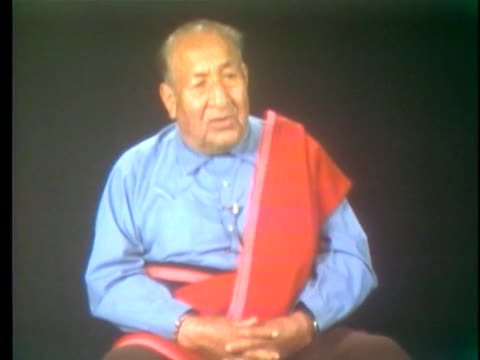
don't know it's kind of crying water and so you name the spring but then it'd be crying springs that's about near as we can get could you tell us about the road you're wearing and as you're telling us about that tell us about we understand that you are an important person in the Native American church where they know my people known as American Indians when when they address a ceremony then they try to dress sort of accordingly
like in the Native American church were wearing boots and cowboy leaves eyes and western shirts it's kind of out of order like so they they try to blend their clothing the color to blend with the ceremonial fire and the purpose of it so when the government give this type of goods to the Indians in their treaty stipulations when like I said they didn't know what to do with one of them made bed covering with it later on were dancing costumes then put it somewhere it fit the purpose instead of packing a buffalo robe of blanket where then they use this and they use it only in ceremonials so
in the this is a type of robe that they pack and it seemed like it's kind of like a uniform the soldier he has to dress certain way so he can be aggressive and you know protect himself and then whatever he has protection of his own body well in our ceremonials in a spiritual way we try to dress to to make the proper appearance so there's these help some time they talk and there's some individual talk in the meeting saying it's good that we have a red blanket when the naive Jesus clashed to the cloth so his blood was red well there's a connection like there's a feeling a spiritual relationship to that as the way he described it on a
kind of color of this and then the blue he said that the sky is blue and everything good it looked like comes from above and he related that way to the blue so this is dark blue but then at the time that sort of a light blue with this and then the dawn himself with like well here's a bracelet here's a blue turquoise and then here's silver that comes from the bowels of the earth that's God's the creators creation we use that hoping that whatever good spirit comes there sees this but then we're in the proper perspective if I use that word we're presenting ourselves in a proper way even to our dress and sometimes the people will paint their face you know with different colors in their clan system
they'll color the face and then they'll they were ties made out of beads you know like click on I don't yesterday and even wear marks and something appropriate to the ceremonial and then strangers it may seem it gives us sort of like power we we talked we pray we sing in now without these things then we'd be sort of weak we'd seem like we'd just be going through the motion but with with all its paraphernalia then weak as we are it gives us sort of a strength to contemplate meditate and then present ourselves in a proper with humility you know so that's about as clear as I can express and close and I'd like to ask if you
have any words that you would like to say to the future generation to older children or to all children the whole what are you going to do here some um What
cigarette are we, what kind of natural gas time? Don't think about that. When the flower is turned into a wood black advertising lists, You can get that February until fixed. Here I give them to you. I have to prepare for it whenever I go. He's working here. We just have to share them it out. Earning money is staying here being there. O God, O King, O Arvina, O Manuhos, O Huataviyotika Ghaigun. Did you want me to say in English? Now, those of you that are listening to this interview, I hope that you will understand what I am trying to say.
For those of you young ones where your life is before you, perhaps you do not know anything about the culture and the religious ways, rituals, the tradition of our people or your own people. What I have gathered and learned from my own people, they always said to try to love one another, have great respect for one another, always tell the truth. And when you are blessed with things, you have extra share with people and be kind to people. And like our elders say, when you do that, the great spirit will bless you and in your past of life, you will run on to something there in your past way where you can pick up, gather it and take it home and use
it. So briefly, this is what I am trying to encourage you as you live, be always mindful of the creator, the great spirit. And whatever you learn or heard about his teachings, try to follow it and you will do yourself good and you will harm no one. Thank you for your attention.
- Episode Number
- #9
- Episode
- Otoe-Missouria
- Producing Organization
- Nebraska Public Media
- Contributing Organization
- Nebraska Public Media (Lincoln, Nebraska)
- AAPB ID
- cpb-aacip-73a311fd41a
If you have more information about this item than what is given here, or if you have concerns about this record, we want to know! Contact us, indicating the AAPB ID (cpb-aacip-73a311fd41a).
- Description
- Episode Description
- This is tape 9/9 with members of the Otoe-Missouria Tribe. The speaker is Truman Dailey. Truman Washington Dailey, (October 19, 1898 – December 16, 1996) also known as Mashi Manyi ("Soaring High") and Sunge Hka ("White Horse"), was the last native speaker of the Otoe-Missouria dialect of Chiwere (Baxoje-Jiwere-Nyut'achi). This footage is incorporated in the series "Nebraska Indian Tales."
- Series Description
- The Junior League Indian Language Project tapes interview elders from Nebraska tribes and include important documentation of history, language, place names, religious traditions, and more.
- Created Date
- 1978-12-15
- Asset type
- Episode
- Rights
- Access to material from Nebraska Public Media’s archival collection is for educational and research purposes only, and does not constitute permission to modify, reproduce, republish, exhibit, broadcast, distribute, or electronically disseminate these materials. Users must obtain permission for these activities in a separate agreement with Nebraska Public Media.
- Media type
- Moving Image
- Duration
- 00:19:40:05
- Credits
-
-
Producing Organization:
Nebraska Public Media
- AAPB Contributor Holdings
-
Nebraska Public Media
Identifier: cpb-aacip-6673faf449b (Filename)
Format: Betacam: SP
Duration: 00:18:28
If you have a copy of this asset and would like us to add it to our catalog, please contact us.
- Citations
- Chicago: “Junior League Indian Language Project Final; #9; Otoe-Missouria,” 1978-12-15, Nebraska Public Media, American Archive of Public Broadcasting (GBH and the Library of Congress), Boston, MA and Washington, DC, accessed November 24, 2026, http://americanarchive.org/catalog/cpb-aacip-73a311fd41a.
- MLA: “Junior League Indian Language Project Final; #9; Otoe-Missouria.” 1978-12-15. Nebraska Public Media, American Archive of Public Broadcasting (GBH and the Library of Congress), Boston, MA and Washington, DC. Web. November 24, 2026. <http://americanarchive.org/catalog/cpb-aacip-73a311fd41a>.
- APA: Junior League Indian Language Project Final; #9; Otoe-Missouria. Boston, MA: Nebraska Public Media, American Archive of Public Broadcasting (GBH and the Library of Congress), Boston, MA and Washington, DC. Retrieved from http://americanarchive.org/catalog/cpb-aacip-73a311fd41a