In Search of the Oregon Trail Part 1
- Transcript
I'm sorry
I I sorry
this is the� And this. But even more than places, the Oregon Trail is the story of people, people like Amelia Stuart Knight. As a younger woman in 1853, with her husband and seven children, she walked from her home in Monroe County, Iowa 2 ,000 miles across the continent to a new life in Oregon. It's also the story of people like Alva Unthank, who carved his name at Register Cliff on his way
to the Gold Fields of California. And it's the story of Brigham Young, who found freedom from persecution for his Mormon followers in the isolated sanctuary of Utah. Together with the stories of hundreds of thousands of their fellow immigrants, these journeys over the plains, deserts, and mountains became one of the most powerful and enduring symbols in American history. But just as importantly, the Oregon Trail is the story of the people the immigrants met on the way. The Native American tribes whose homelands lay in the path of the migration. In this century, a pervasive myth has grown and overshadowed the truth of the Oregon Trail experience. Through the popular media, the complexity of that experience has been reduced to one -dimensional heroes and villains.
In reality, there was adventure and danger. But the challenge for us today is to see beyond Hollywood's fictions. Another myth is that this is a story that came to a conclusion over a century ago. In truth, there is no end in sight. Many of the issues that shaped the past and the forces that motivated the Overland Travelers are still with us. Like those who set off before, we head out in search of the Oregon Trail and what it tells us about our country and ourselves. Most Americans believe
they know the story. In the middle of the last century, intrepid pioneer families set out from the Missouri River on an overland journey of 2 ,000 miles across the plains, deserts and mountains to the far west. Banded together in long caravans for protection, their possessions and covered wagons, the pioneers faced incredible hardship and danger, even Indian attack. Progress was slow, the wheat turned back, many died, but most endured and succeeded, arriving destitute but hopeful in the promised land of Oregon. Through their efforts, the United States became a nation which span the continent. Told in this simple way, it's an epic story, almost biblical in proportion, and in fact much of it is true. The Overland Trail
is all about the significance of the frontier in American history, and that significance I think is a series of paradoxes, our wanderlust as a people, and on the other hand our need for community, our love of nature and our desperate need to develop. Our fascination with native people and the wars of dispossession that made this country. Those are the elements of our real history, and those are the elements that we'll need to confront to construct our new national myths. It's easy to see the appeal of the older Oregon stories, what they are is about small groups of people,
of tremendous courage, enduring great hardship, to move into an Eden that was awaiting them, in which they then made into this welcoming civilized country. And it's not so much that there's a harm in that particular story, as much as that story erases a whole bunch of other stories, a whole bunch of stories that I think have to matter to us great deal as a nation. One of the things that that story wipes out is the story of the people who lived here already. Today we talk about drive -by shootings, well I think that's where you see the first earliest drive -by shootings in America was along the trail. You have Europeans coming by and shooting at Indian people in their own land. You know, talk about unwelcome guests. Because it is so symbolic, it's important to see the Oregon Trail experience as it really was, to strip away the myths that, for example, make the Native Americans
much more dangerous than they were for most of the time. And indeed, to strip away the myths that make the whole experience much more adventurous in a film -like way than it really was. It's important to see real people in their daily lives, because that's our true history. To search for the truth of the Oregon Trail is to travel many different ways, both literally and intellectually. At the most basic level, it's seeking out the actual root of the trail. Today, only the most isolated stretches look as they did in the 1840s. The land has changed. There are trees where none stood 150 years ago. Irrigated crops grow in places once too dry to farm.
Interstate highways connect modern cities and areas once considered a great desert. Original accurate images of the Old Oregon Trail are rare. Because the migration reached its peak in the mid -19th century, most of the trail experience was not photographed. Only after the Civil War did photographers become common in the American West. By then, traffic on the trail had slowed to a trickle. What we have are the sketches and notebooks left by the emigrants. Few of them were competent artists. Those who were tended to concentrate on the notable geographic features. So it's possible to find dozens of sketches of a place like Chimney Rock, but there are very few pictures of typical camp life. In the very early
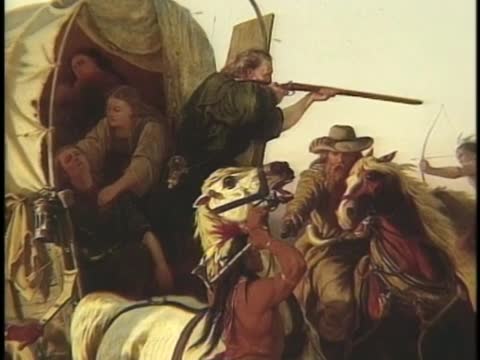
trail years, several professional artists went west. Alfred Jacob Miller traveled with a fur trade caravan. Carl Bodmer wanted to capture an accurate view of the plains Indians. George Catlin had similar goals. Their paintings depict a way of life on the verge of enormous change. Later, many artists would portray the Oregon Trail as a noble undertaking. So fused with golden light and laced with the exhilarating adventure. These images have become icons of American history and help to create the myth. Few of them depict the reality. To get closer to that reality, we have to rely on the written diaries and reminiscences of the travelers. Official records, popular guidebooks of the time, and the
oral history passed down from generation to generation of Native Americans. Even these records are subject to broad interpretation. Simple facts, such as the estimate of how many went west, vary between 250 ,000 to half a million people. Yet for all these difficulties, once we begin to travel the trail, to seek out the stories of the people who lived it, what's revealed is a fascinating and complex chapter of our history. The Oregon Trail begins on the banks of the Missouri River, in the heart of what is now Metropolitan Kansas City. In the early 19th century, this was called Westport Landing. Every
spring, for three decades, beginning in the 1840s, river towns like Westport, Independence, and St. Joseph competed to be the jumping off point. There was big money to be made. It was here that the immigrants purchased whatever supplies they hadn't brought with them from home. Most of the immigrants were practical -minded farming people. The purchase was taken lightly. Because space in the wagons was precious, every item had to serve a purpose. What the guidebooks told them, and what the people who had the very earliest people told them, was that it was just like home except better. And that's what they wanted to recreate. And the women, and I'm sure the men as well, tried to think of everything they would need to take with them, both in a practical sense and in a personal sense. Bibles, and medical guides, and for women's sewing
supplies, and fabric, as well as grandmother's quilt, and China that had been in the family for a long time. And mementos that have personal meaning. It's quite an undertaking. You're trying to pack not just for a six or seven -month trip in terms of the food and whatever the family will need in terms of bedding and clothing for that, but for what you'll need at the other end. At the peak of the migration, there were at least a dozen different guidebooks, some more factual than others. For provisions for each person, you want a barrel of flour, or 180 -pound ship biscuit that is killed right. 150 to 180 pounds of bacon, 25 pounds of coffee, 40 pounds of sugar, 25 pounds of rice, 60 pounds of beans, or peas, cake of clear cooked beef suet, cake of lard, 30 to 40 pounds dried peaches, or apples, and also some molasses and vinegar. The
vast majority of Overland immigrants came from the adjacent states to the so -called jumping off spots. They came from Illinois, Tennessee and Kentucky, Missouri, Arkansas, Iowa. Certainly there were people from further distances, but by and large, they were Midwesterners. They were also movers. Most of them had moved at least once, some, three, four, eight, even five times. And they were middling folk, as they weren't wealthy, although it was impossible to take the trip without some store of capital, acquired a 500 to a thousand dollars to move a family of four across the trail. Raising and spending 500 to a thousand dollars to make the move was a significant risk in the 1840s. Most immigrants were third and fourth generation Americans, farming
people living on the western fringes of a shaky American economy. There was a worldwide depression in the 1830s and the 1840s, and it affected the United States in the panic of 1837. Farm prices collapsed, mortgages were called in, people lost their farms, and the federal government had a fire sale of a public land. The unclaimed lands were bought up by speculators, and were no longer eligible for squatting. So by the early 1840s, people were really feeling the pinch. Always driving migration in the United States, and it's just as true of the 1840s, 1830s, and 1820s, is a size of families. American farm families want to secure land for their children. To secure land for your children is best to go where land is cheap. It's always cheaper for their west, but that just raises the question again. Why this
far west? Why coming all the way to Oregon? And that's always going to be the question that haunts historians, because at the basic level, the migration to Oregon made no sense. It was not a purely rational decision. The path was dictated by geography, destination, and necessity. The trail had to be near good water and grass, and fuel for cooking and warm. As the immigrants leave the Missouri, they cross the prairie, following first the Kansas, then the Blue Rivers through what today are the states of Kansas and Nebraska. Timing is critical. The Overland voyage of 2 ,000 miles takes about six months.
They must leave late enough in the spring for the forage grass to have grown. But not so late is to get trapped in the early fall snows of the western mountains. That's what happened to the Donner Party in the winter of 1846. The lurid saga of death and cannibalism was just one of the stories that fueled the immigrants anxieties. When all is ready early in May, they set out on what they expect to be the great adventure of their lives. The excitement of beginning, mixed with the fear of the unknown. And for almost everyone, the sadness of leaving family and friends, they might never see again. We intend tomorrow to enter that great,
waste wild that now lies west of us. I have seen many go out, and I have seen no countenance free from evidences of strong emotion. These people knew that there are bound to undergo an experience very different than anything we've undergone before. And the experience isn't just the move. All these people have moved before. There are people who are born in movement. But this migration, this migration across 2 ,000 miles is something different. And the best sign we have that they regarded is something different is that they commemorated an unusual number of them kept diaries. Not only did they keep diaries, but later on when they give the stories of their lives, these are the things that lingered in their mind. This is the moment almost that we were most alive. This is the moment that when I look back matters and is the most significant. April 10. This day we started on our overland journey to Oregon. We were the first to leave camp in the morning about 9 a .m.
We stopped at St. Joe until 2 p .m. when we left for Old Fort Carney, where we expect to cross the Missouri. We drove about seven miles and then camped for the wet rainy afternoon. There are five messes of us eight wagons and three families with children. People wrote faithfully in their little three by five diaries every night. Some of those are almost unreadable now because they're in pencil and it's blurred. And they're very exciting to look at in a personal sense because you have a feeling you're right there sitting in a wagon as someone is writing it out every night. Each advanced step carried us farther and farther from civilization into a desolate, barbarous country. But our new home lay beyond all this and was a shining beacon back in the sun, inspiring our hearts with hope and courage. I could only hope
that we would get through safely and was much gratified that we were at length on route. Our watchword westward to hoe. To people who make their living from the land, the plains and mountains of the American west are a vast wasteland, unsuited to their needs, even dangerous. But to the tribal people who live here, this is a nurturing environment, a great mother. Much of the tragedy of the Oregon Trail stems from this profound misunderstanding. Most migrants as they set off from Missouri really did think of themselves as moving off into the wilderness. And by the wilderness they thought about it they would have meant untouched land, unland, unshaped by human beings. But of course most of the area they were covering was nothing of the sort that Indian
peoples had used and shaped this land for centuries indeed for millennia. They shaped it through fire that they determined where trees would grow and where they wouldn't grow along the plant. They determined when grasses came up because they burned to bring up early grasses in the spring. They of course had planted crops over much of this region. They shaped entire landscapes. It's connected to the word bewildered. A wilderness is a place where somebody feels bewildered. And the place that makes one person feel bewildered can be the place where thousands of other people consider it home, consider it familiar, know where they are. But I guess I would say don't take away the bewildered person's experience. So at the behalf of white folks thinking they were entering a wilderness, they were bewildered. And they have a right to put on record, their bewildered mind. They do not have a right to say that it was a vacancy or that no significant human presence was there. This was not a wilderness. There were well established trails. There were regular
campgrounds that Indian people used on a regular basis. The idea that they're coming into an uninhabited wilderness was totally a misperception. And in fact I think that maybe it was used to justify that invasion. The Oregon Trail immigrants aren't the first Americans to think of the West as a wilderness. 1804. President Thomas Jefferson authorizes the first official American expedition across the continent to the Pacific coast. It will be an advanced reconnaissance for the coming invasion. Mary Weather Lewis and William Clark travel for more than two and a half years following Jefferson's orders to discover the soil and face of the country. The trip takes on
added urgency with news of the Louisiana Purchase. For $15 million the nation doubles in size. Francis Napoleon Bonaparte sells the United States the right to govern nearly a million square miles of western land, Indian land. A right assumed without regard to the people living there. Later the US government makes treaties with these Native American tribes as though they are sovereign independent nations. But in 1804 the agreement is with the French colonizers. In the Louisiana Purchase Native American rights legal or otherwise are not a consideration. We were now about to penetrate a country at least 2 ,000 miles in width, on which the foot
of civilized man has never trodden. The notion of civilized is rooted in this concept of duality where there are two types of people. One is the civilized man, the other is the uncivilized man. And the Europeans of course considered themselves as being civilized and they considered others who did not have Christian values as being uncivilized. The notion is that the people living there are not using the land as God had intended. Therefore those people who lived righteously in God's way had a right to take over that land and appropriate it for their own use. And if they were civilized then they had a greater right to do so. Partially what they are doing is ignorance. Part of it is this incredible cultural arrogance where civilized becomes a term of honor which is reserved only for Europeans and their descendants.
There have been Indian people there for thousands and thousands of years. There's also been French people, British people, Russians. If you go to the Northwest you find allutes from Alaska, you find Hawaiians, Spanish in the Southwest and there's tons of people coming into the West from all over. When Lewis and Clark crossed the continental divide they are no longer in Louisiana Purchase territory. Across the Rockies our lands claim by the British, the Oregon country. What the explorers find here stirs their imaginations and for decades to come, quets an American hunger for land. William Clark is quite an excellent cartographer and the Lewis and Clark maps are extremely detailed. After the expedition, Clark is appointed first the governor of Missouri territory and then the superintendent of Indian Affairs. He has an office in St. Louis and on the wall of that office he has an enormous map.
It starts with the Lewis and Clark map which he draws on the expedition. But every subsequent expedition, Stephen Long, Zebulin Pike, information gets filled on to that map and it's not only government information, it's also corporate information from fur trapping companies and individual private information from individual trappers and traders who are out there in the region in the landscape. That map in that office is the place where the most comprehensive knowledge of the West is gathered and it's knowledge that's under government control. Through their published memoirs and journals, Lewis and Clark and other government sponsored adventurers greatly expand 19th century American knowledge of the new territories. Legendary military explorers, Stephen A. Long, Zebulin Pike and John Charles Fremont quickly become national heroes to a literate and curious younger generation of Americans. The European discovers
the new world and like Adam moves through it bestowing names on the animals and the places. This is the colonial fantasy, the fantasy of discovery, of exploration. To cast oneself in that role is the ultimate privilege of the conqueror of the colonialist. This I think was something that the Overland experience offered to ordinary people, it was their chance to participate in this great colonial adventure, to be explorers themselves, to become the night errands of the West. After a short time, the thrill of beginning fades and the immigrants settled into their new routines. For the next few months,
the prairie will be their home. The prairie, oh the broad, the beautiful, the bounding rolling prairie, all the extravagant descriptions of foreign scenery I have read would not seem extravagant here. Imagine the ocean when the waves are rolling, mountains high becoming solid and covered with beautiful green grass and you have some faint idea of it. Could Eden have been more beautiful? For every poetic diary entry, there are dozens which speak only of weather and travel conditions in a series of long monotonous days. Men are temporarily relieved of their farm chores, but there is plenty of hard physical work with wagons and animals to make up for it.
Most of the wagons came from the farm, they were constructed at home. A minimum load for a family of four would have been about two tons, which is the carrying capacity of a wagon. That does not include any of their tools or furniture. There are plenty of records of people setting out with four or five in the party, in nothing more than a 15 foot farm wagon. These people would have had to overload the wagon and probably dump much of their cargo along the way. After the first few years, immigrants rarely travel in organized wagon trains. Independent minded farmers resist taking orders. Most travel west in small groups of family and friends. People seldom ride in the wagons. They are too heavy and take up useful
space. In the muggy, June heat, oxen improved their worth over horses and mules. Oxen endure the fatigue and heat much better. They do not ramble far from the encampment. They are not liable to be stolen by the Indians who are aware that they travel so extremely slowly that it would be impossible for them to drive them so far during the night that they could not be retaken during the next day. For the next five to six months, day in and day out, the routine is the same. Up early and walk. Walk. Walk. On a good day, the immigrants could expect to make 15 to 20 miles. This is a way of really knowing the world and experiencing the natural world through work, through labor, through this kind of bodily knowledge. It is something that is
vanished from us. These are working people. These are people who are in intimate contact with the natural world. What they think about is how far you walk during a day, what it is like to walk over, what kind of shape animals are in. They think about the effort of moving through space, not as we do when we drive along the trail, but the effort to put one foot in front of the other, the sweat, the tiredness, the way you ache at the end of a day, the way that you long for sleep even during a noon day, stop. Everyone gets up in the morning at some impossible hour, like four o 'clock or something like that. And while the men are gathering together stock and hitching up the wagons, the women are putting away all of the nighttime stuff, getting the children rounded up, getting everybody fed, getting breakfast made, getting everything ready to roll. And then as the train moves out, after breakfast and travels for four or five hours until the noon time stop, the women are keeping track of where the children
are and trying to make sure that they're not wandering off or in danger. Chad had a fair and narrow escape from being run over, just as we were all getting ready to start, Chad feel the rascal, came around the forward wheel to get into the wagon. And at that moment, the cattle started and he fell under the wagon, somehow he kept from under the wheels. I never was so much frightened in my life. There were innumerable jobs collecting fuel, tending stock, watching fires, cooking that children did, and probably even more importantly, they were responsible for watching their younger sips. And in fact, it was the youngest children on the trail who were probably at the greatest risk, because without jobs to do, they tended to run alongside, to get into trouble, tended to get run over by wagons,
bitten by snakes, drowned in rivers. So in some ways, the youngest children without responsible working roles were the ones who had the greatest difficulty. For most, it is travel every day, although the more observant keep the sappers than rest on Sundays. From sun up to sundown, the only break is the noon time meal. The noon time stop was usually pretty brief and women didn't cook at that meal. They fed their families cold food which they had prepared the night before. And then the wagon train starts up again and travels for another five or six hours until they find the spot where they're going to spend the night, which is typically a spot that has both wood and water and enough room for everyone. And it's at that point, after the men have unhitched the wagons and turned the stock loose, that the men who have been driving and drove all day long can finally relax for a while.
But it's precisely that point that the women have got to swing into full scale activity because they have to make dinner over an open fire in whatever conditions they find, whatever the wood situation is. And so typically you find women working together in groups, men working together in groups, except for a few hours after dinner. That's the only time that husbands and wives, for example, and families have to spend together. As the immigrants cross the open prairies of Kansas and Nebraska, they feel exposed and on edge. They
know they're at the mercy of the weather that accidents could happen working with animals and heavy wagons. And then there is the specter of disease. Fully half of the deaths happen between 1850 and 52, when cholera erupts in the overcrowded conditions of the Gold Rush and Mormon migrations. But in most years, the death rate on the trail is about the same as or even a little lower than the rest of the nations. Still, most of those who die are young people. By our standards, the trail is dangerous. By 19th century standards, no, the trail is only mildly dangerous. It's a kind of journey in which many of the people who died by accident and some of the accidents are so ridiculous that they sometimes seem to be this kind of genetic selection. When you put a loaded gun in a wagon and you have the barrel facing outward and the wagon is bumping and you try to grab the gun and take it out
with the barrel pointing to you. It might be just as well for the success of the whole party that you're eliminated right there. More immigrants die from accidental gunshot wounds than from Indian attacks. A significant portion of the money allotted for the trip is spent on firearms. Many men harbored frontiersman fantasies inspired by the Western explorers, Daniel Boone, or James Phenomore Cooper's leather stocking. Although every farm family certainly had their hunting rifle, most of these men had not had the opportunity to hunt. And for them, the chance to move out into the Great American West across the Overland Trail opened this wonderful opportunity to play this historic role, to become leather stocking, to become Boone, to hunt the buffalo,
to see the indents. By the late 1840s, increasing traffic and hunting are driving the bison away from the trail. When you read the accounts of men, they are obsessed with finding buffalo. The vast majority are disappointed in their hopes. They see not a single buffalo. For those trains that encounter buffalo, generally there is a stampede, not in the buffalo, but of men out onto the prairie to hunt them. By and large, this was a chance to participate in a fantasy. It had very little practical implication. There is irony and humor in the image of trigger -happy would -be Daniel Boone's racing around the prairie. But it isn't humorous to people who depend on the buffalo for everything. People like the
ponies. For centuries, the ponies located their earth -lodged towns and farms near their hunting territory, along the Plat River. Late in the 1840s, as traffic increases with the Mormon and California migrations, the ponies have to cope with the devastation caused by wave after wave of nomadic white people. One of the first things they did upon seeing buffalo was to organize parties and go slaughter as many as they could. In the U .S. society, it was perhaps a right of passage for the young men to kill buffalo. They tended to kill as many buffalo as they could, scatter the herds. The
buffalo were considered to have been given to the ponies by the creator. And therefore it was a sacred animal. The ponies needed buffalo for their ceremonies. There was a great deal of religious significance and preparation that went into the hunts. It was very important for them to conduct these ceremonies or an apony concept of things. Some tragedy would befall the world and the pony people. Just as today's farm economy in Kansas and Nebraska relies on corn and cattle, the ponies depend on corn and buffalo. It's a centuries old way of life. Nebraska is the ancestral homeland of the pony people. I am a member of the pony tribe and our people have been here. I guess not since time immemorial, but for a substantial amount
of time, they were established there before Coronado went to the Great Plains in the early 1540s. The ponies believed that they owned the buffalo and that through the buffalo they owned the land. The land that the buffalo ran over was the ground that the ponies owned. Plabri Ravalli was the center of pony culture. Overlanders kill buffalo, destroy forage and bring disease. And they refuse to acknowledge that the pony have a right to expect anything in return. The conflict is in large part due to white attitudes. An image of Native Americans has been forged from the folklore surrounding the earlier Indian wars back east. People coming across
the Oregon Trail, the people making a decision to migrate to Oregon, are by and large people who have had no immediate experience with Indians. They heard stories about Indians. They heard stories from their parents. They're going to be surrounded by symbols, by pictures, by paintings, by cheap woodcuts, which very often would produce this experience of Indian attack. We tend to think of immigrants as being these sort of poor illiterate backwoodsmen, not really the case. I mean, they're reading things like James Phenomore Cooper. There's in the 1820s and 30s, there's a resurgence of older captivity narratives, Puritan and pilgrim sorts of stories about being hauled off into the wilderness, taking prisoner by savage Indians and sort of being forced to undergo all sorts of abominations. There's a sense that Indians are holding the land captive in a similar manner to the way that they, one might say, they had held white women captive, white children captive. These are the sorts of attitudes that the people who will become
the immigrants on the Oregon Trail are growing up with. And as they move out, their attitudes are going to be what you predict they would be. They're well armed, they're wary of Indians, they distrust Indians, and they never have any doubt of their right to displace Indians. It just never occurs to them that there can be a moral question involved in most of this. And what's odd about all this is here's a people who are occupying a continent, who are displacing Indians, but who tend at all times to create an image that they're the ones being attacked, they're the ones under siege. And so what you'll have is these uneasy encounters all up and down the Oregon Trail. As in fact, they will move through Pawnee country and they don't hesitate to let their animals graze in Pawnee cornfields. I mean, they'll destroy Indian corn crops in the way they'd never allow their animals to do that if that was a white farming community. I think they've been very difficult for a white American at that time to
comprehend exactly what the buffalo meant to the Pawneys, what the sacred corn meant to the Pawneys, and how their incursions into the great plains were disrupting Pawnee life. And to try to compensate for this, the Pawneys would sometimes congregate at river crossings and ask for 25 cent total per wagon to cross, sometimes 50 cent total. If the wagons people refused to pay, the Pawneys would sometimes follow that party for several days and take livestock belong to those people, sometimes they would plunge the wagons. Sabbath, June 5th. Yesterday, the word was that we must travel today because we were in the Pawnee country and it would not be safe to lie still. About 200 Pawneys came here three days ago and are lying here with us, but with what intentions we know not. There will almost steal a horse from under his rider.
We are not afraid of our lives, but we find them very annoying. The Pawnee Indians are the greatest thieves I ever saw. The best way I think to civilize or Christianize Indians is with power and lead. Given the mindset of the immigrants and the amount of damage sustained by the Pawneys, it's not surprising that sometimes violence does erupt. But contrary to popular mythology, these events are rare. The Hollywood version would have immediate gunfire, immediate violence. The fascinating thing is that that was not the reality, that the reality is a lot of peaceable interchanges, not necessarily wonderfully friendly, sometimes really quite apprehensive on
both sides, but much more interesting than the Hollywood version. White men who were prepared to defend themselves and thought that they would have to fight their way across the continent, often discover that that's not at all what they have to do. The more typical encounter is Indian people curious, Indian people coming into camp and asking for something, asking for food, asking for coffee, asking for some physical artifact, and white is puzzled by how to handle that. Well, we'll get out of control. These are these bad Indians about to become thieves. So it's usually a fairly congenial meeting, but with undertones of suspicion and distrust. The fate of the Pawnee uses tied to the fate of the buffalo. The Oregon Trail is the beginning of the end for the American bison. The Great Herd is split into two
by the traffic along the plant. Then, through commercial hunting, the animal is quickly eliminated from the Great Plains. From a population once numbered in the millions, by 1890, the bison is reduced to a few hundred animals. For the Pawnees, the Oregon Trail brings disease, starvation, and despair. In 1876, the Pawnees reluctantly give up their homelands and are moved south to a reservation in Oklahoma's Indian territory. At the beginning of the Trail, the Pawnees were a powerful group in the region, but still they did not have the strength to stop the traffic. So some expected, I think, a catastrophe to happen as a result of the destruction of the buffalo herds. And I think,
to a large degree, we did see that having the Pawnees numbers diminished very dramatically, reaching a low point around the turn of the century of a little over 600 people. The plant river that the immigrants follow through Pawnees country and beyond is a godsend, braided, sandy, full of silt, it is three miles wide in some places. Too thick to drink went to joke, too thin to plow, but broad, flat, and unnavacable as it may have been. The plants abundant water, grass, and jettles of rain are the keys to crossing
the continent. The great news about the American continent is that it has east to west running rivers where you need them, if you're trying to get from the Midwest to Oregon. So the plant river, for instance, is an enormously important gift of providence to overland travelers. You can go river by river and you never have more than 50 or 60 miles of waterless crossing and without that, it's Australia. Modern highway builders continue to recognize the logic of following the plant. In many places, the actual trail ruts are paved over with interstate 80. By mid -June, the immigrants are passing out of the prairie and into an area of sparse rain, few trees, and short grass west of the 100th meridian. The early 19th century explorers had labeled this region a great desert. Today, with irrigation, it's good growing country.
Some of the immigrants see a potential here, but they don't consider settling. It is against the law. Until the mid -1850s, this is still officially Indian territory. The description of this country is generally embodied in the pithy expression, it can never be settled. The plain truth is, it is the most splendid country in the world, but without timber. When the Overland Trail began in the 1840s, the general impression was that the prairie lands were not suitable for farming. The idea was that where there were no trees, there could be no agriculture. But as we move into the 1850s and 1860s, in fact, people are settling in Iowa and Nebraska and taking up land. In fact, the number of people who went overland to the far west is
a relatively small number compared to the number of people who made farms in the Midwest at the same time. Perhaps 250 ,000 people went to the Pacific coast, and during that same quarter century, several million settled the states of the Great Midwest. The immigrants passed the forks of the plant and forward the south plant. Then it is a dry stretch north across the high -table land towards windless hill. Here, the deep ruts formed by hundreds of thousands of wagon wheels are still visible. This is one of the few segments of the original trail remaining in the Great Plains. Up ahead, in the North Plant Valley, the first of the spectacular monuments of the American West begin to appear on the horizon.
Almost everyone, men and women, commented on the famous milestones, all the really dramatic pieces of western landscape, and then occasionally you get women with a finer eye who look at the land and what's growing on it and wonder about it. It is a curiosity indeed, a rock, or rather a hard clay, standing alone, towering in the air, perhaps 300 feet. All of the lofty rocks along here are composed of the same material. This, in my opinion, had once been a sea. The landmarks indicated our progress and helped break the
monotony. Like the milestones along the journey of life, there was one last to pass. They have now been traveling almost two months. The Plains portion of their journey is ending. They are headed toward the mountains. The immigrants continue west through the Mitchell Pass at Scotts Bluff. Ahead is territory claimed by tribes very different from the Ponies. These nomadic bison hunters are themselves relative newcomers to the Great Plains. These are the Lakota Sioux, and they're allies, the Cheyenne. The immigrants coming across the trail, you know, their whole image from what they've learned about in the east
is that there are Indians out there. And they don't distinguish between the Pony or the Oto or the Iowa or the Sakina Fox, or further west you go the Lakotas and the Dakotas and the Nakotas and the Cheyennes and the Chishonis and the Crows. They're all Indians. And yet each one of these tribes are distinct, separate, sovereign nations, and all of them at one time or another were present along the trail. You may develop a relationship with the Ponies and say, hey, we've got a good relationship with the Indians, you know, and go 25 miles and encounter more Indians and you think you've got a good relationship with them, but they're not Ponies. They're another tribe. In today's world, the Lakotas have come to embody the classic image of the American Indian. These are the people of the T .P. and the War Ballot. The mounted warriors of the Plains riding at
top speed through herds of stampeding bison. These are the warriors who will bring down custer and inspire generations of painters, novelists, and filmmakers, first to vilify and later to lionize them. The complex American relationship with the Lakotas begins on the trail. They look quite intelligent for Indians and superior to what I had expected to see. Some of them are now practicing with their bow and arrows for the amusement of the immigrants. These Platsu, by the way, are the best Indians on the prairies. Look at their conductor in the past summer. Of the Western immigration which rolled through their country this year, not a person was molested, not an article stolen. Such good conduct deserves reward.
By the mid 19th century, most of the northern Plains is controlled by the Lakotas Su and their allies. As with so many other Native American tribes, fur trappers and traitors are the first European Americans to interact with the Lakotas. Many marry Lakota women and are adopted into the tribe. You had this wonderful growing symbiotic relationship between the fur traitors, the Indians. It was generally a positive interaction. It was an exchange of cultures. It was an exchange of ideas. It was an exchange of trade goods. And as early as 1825, the relationship appears to be a good relationship. You don't see very much hostility. It was almost like a paradise. And that changed. And I think it began to change in about 1840. When you see this greater influx of movement along the trail, more people coming begin to ruin
paradise. The Lakota are really an expanding empire on the plains. They move out from Minnesota. They move to the Black Hills. They move south into Nebraska, East or West into Wyoming. They're taking territory constantly from other tribes. And when they hit the plat, they bump into a rival empire with the United States. The Easterners coming across the Europeans coming across the trail could be easily intimidated by the savages. Because of the stereotypes that they have in their mind, they're going to kill us if we don't kill them. And so when they come to us and they say, we want something, we better give it to them. And so you see Indian people taking advantage of that too. When you think of these people, the Lakota is sweeping down out of the hills. You know, a lot of these guys were very, were very large guys. You know, they're painted. They've got long hair. They're on their ponies. You know, I mean, they're very tough customers
sweeping down to a wagon train. Well, I think for a lot of overlanders, they were scared to death when they see something like that. As with the ponies, the Lakotas insist on some kind of toll for passage. But the Lakotas are more openly aggressive. Some overlanders complained to the government. One of the things that the government did was it would take individual Indian leaders and take them back to Washington on the train. And they would have to pass through Chicago and Cincinnati and all kinds of towns. And they would see just how populous United States was. And they would come back to their people. And oftentimes they would say, look, there's no way we can fight these people. We have to figure out some way to accommodate, to figure out some way to get along. 1851, a great treaty council is called at Fort Laramie near today's
Nebraska Wyoming border. Members of eight major planes Indian nations attend, many of whom are traditional enemies. When over 10 ,000 arrive, the council must be moved from the fort to a place where there's enough grass for all the horses. Here at Horse Creek, the United States attempts to set tribal land boundaries. What the government is doing is constructing a mental map of the region, of saying the Lakota are going to be here, the Shoshone are going to be here, the Pani are going to be here. And in theory, then those tribes know what their boundaries are and they're not going to be engaging in intertribal warfare, which the government sees as something that bleeds into the trail and creates a lot of problems for immigrants. The second thing that the treaty of 1851 does is it allows the government a right of way for the road and for government military posts. Negotiating a treaty provides a legal basis for events which have already
occurred. The trail has been in use for over a decade. The army has already bought or built forts. With the increased traffic from the migrations not only to Oregon but also the California and Utah, tensions escalate. Many Lakotas are opposed to the rigid boundaries dictated by the government. You have split the country and I don't like it. What we live upon we hunt for and we hunt from the plat to the Arkansas and from here up to the red beaut and the sweet water. These lands once belonged to the kaiwa and the crows, but we, the oglaulas, shayans and arapahos with these nations out of them. And in this we do what the white men do when they want the lands of the Indians. In the end the tribe signed the treaty
and pledged to remain at peace. To compensate for the loss of game and other damages the tribes are promised annual payments of food, clothing and trade goods. Today's legacy of reservations and government payments to the tribes of the Great Plains originates with the horse creek treaty. They were acting in the best interest of Americans coming across the plains and they needed to keep that trail open. In fact, there was a lot of deceit on part of the United States government to keep the trails open. They would make promises that there was no way that they could keep. First of all, the area was too immense to even try to do some of the things that they suggested in the Treaty of 1851. For a few years the trail remains relatively peaceful. Then in August of 1854 and Wyoming near the original treaty site, a band of Lakotas is camped waiting for their annual
treaty provisions, already several months overdue. Where these irrigated fields of sugarbeats now stand, a stray cow belonging to a Mormon immigrant wanders into the Lakota camp. It is shot and butchered. The cow's owner complains to the military at Fort Laramie. The Lakota leader offers horses in exchange for the cow, but the Mormon is not satisfied. A group of 29 soldiers under a brash young lieutenant named John Graton is sent to arrest the Lakota responsible. The leader of the Sue people who were there just by the nature of his responsibilities in that tribe is not going to let that happen. If he let that happen, that would diminish his significance as a leader in those people. So he offers a number of different compromises and none of them are satisfactory
to Graton in the military. They turn around and a gunfight starts, somebody gets shot and Graton is men are all killed. Fearing reprisals, the Lakotas flee, but incidents of violence increase. The army sends word that any Lakotas found north of the North Platt are to be considered hostile. Here in the valley of Bluewater Creek, a few miles north of the North Platt, in August of 1855, Brigadier General William S. Harnie surprises the Lakota camp. Led by Little Thunder, the army kills more than 130,
mostly women and children, and in prisons many of the survivors. He was going to teach these Indians a lesson. In fact, Harnie was trying to make that point. I'm going to teach these people a lesson. They're never going to forget. Well, the Indian people didn't forget it. And from that point on, I don't believe that there was this positive, interactive relationship that had been existing prior to that ever existed again. It was truly a hostile environment. The 1851 Treaty, the Mormon Cow Incident, and Harnie's retaliation at Bluewater set the stage for decades of struggle between the army and the Lakotas for control of the Northern Plains. That armed conflict will continue until
1890, with the slaughter at Wounded Knee. The sight of Fort Laramie up ahead means that the overlanders have breached an important milestone. Very few change their minds and turn back after passing this fort. The easy part of the trip is over. From now on, each mile will come at a greater price. During the late 1840s and early 1850s, as tensions with the tribes increased, the government built or took over a number of forts along the trail. Some, like Laramie, were originally fur trade posts. Like
many others, Laramie is situated near a trade route where tribal people have gathered for centuries. The overlanders see the fort not only as a place of protection, but as a post office, general storm, hospital, and repair shop. Nothing remains of the original fort. These buildings were placed in the 1870s. Today, they are a monument to the federal government's role in the development of the West. The image we have of this migration, which makes it a sort of folk migration, a migration which breaks free from the country and ventures out into the unknown. But in fact, when you look closely, that's not exactly what's happening here. That as the settlers begin to move west, relatively quickly, the federal government is going to intervene in dramatic ways in the journey. The U .S. military before the Civil War is small, but of that minuscule military, 90 % of it is stationed
out along the western trails to protect immigrants from Indians. But more than that, government expeditions are going to be dispatched into the West, which essentially are going to create road maps, instruction manuals for how to make the journey. The first and most important of these government manuals is a report by the Swashbuckling Army Pathfinder, John Charles Fremont. Fremont would go on to become the Republican Party's first presidential nominee in 1856, four years before Lincoln. His ambitions are aided by his powerful father -in -law, U .S. Senator Thomas Hart Benton. Fremont was in charge of the topographical core's exploration of the Far West in 1843, and he actually, his wife, Jesse Benton Fremont, wrote his report, and it became the first government report
to become a best -seller in American history. And many of the Orville and immigrants learned about Oregon and the Far West by reading this government report, and actually many took it with them as a guidebook. Fremont as an explorer was pretty much a mixed lot. I mean, he had a real talent for leading his men into places that they couldn't get out of, of getting lost in mountains and winter storms, of having people resort to cannibalism. These are usually not the kinds of things that make your reputation as an explorer, but the kinds of things that could fade away when Jesse Fremont wrote the reports. There's no question again that man as well as women felt fear in going on the Overland Trail, and all of those people took some comfort in knowing that someone had gone there before them, and gone there so confidently and so masterfully. And that's the real magic of a Fremont sentence is never a moment's doubt, lack of confidence. He uses the verb, I determined over and over again. He doesn't just do something, it's always announced with that.
I determined to go here, I determined to do that. So it is a celebration of the American will. The planes are vast, the mountains are high, the American will is more vast, capable of greater heights. So I think the Bible and the reports of John C. Fremont were the most frequently carried texts. We had accomplished an object of lot of all ambition, and beyond the strict order of our instructions, we had climbed the loftiest peak of the Rocky Mountains and looked down upon the snow a thousand feet below, and standing where no human foot had stood before felt the exaltation of first explorers. Fremont was mistaken on at least one count. The peaky climb was not the highest in the Rockies.
As the immigrants push farther up the North Platte, many begin to realize that their true enemies are not the Native Americans, but time and geography. They skirt north of the Laramie Mountains, the first true mountains they've seen. Here the rugged landscape of the American West begins to assert itself. The trail is determined as much by where it can't go, as where it can. Soon the Overlanders pass register cliff, many pause to carve their names and the year of their journey. Each inscription represents an individual's pride and hope. Alva Unpanc,
a teenage boy from Wayne County, Indiana, traveling with friends and relatives to the California Goldfields. They stop here on June 23, 1850. A short distance from register cliff, the trail narrows as it climbs out of the River Valley to cross limestone hills. Tens of thousands of wagon wheels leave an indelible record of their passing. To the west the land begins to rise, the vegetation changes and the soil thins to rock and sand. Here in the Wyoming desert, five days after leaving his name at register cliff, young Alva Unpanc is stricken with cholera. The next day from their camp on the North Platt, Alva's friend Pussy Graves writes,
Late by the day to Dr. and Nurse Alva, June 30, Alva getting worse. It's quite hopeless, complaining none. July 1, Alva rapidly sinking. July 2, in the early morning, Alva died. Alva lay calm, bore his suffering patiently and uttered not an armor or a groan. If it is father to be of good cheer, his child has paid the great debt of nature. For cure to large, neat headstone, Solomon Woody carved the inscription. There are a number of diaries in which literally day by day
women noted the number of graves that they passed. And you find these dreadful diaries that say past ten graves today, past five graves today, past 15 graves today. And there's a tremendous amount of concern about safely burying someone who dies. And the greatest expressed concern is of having to bury someone along the trail and never be able to come back to that grave again. Alva is buried at noon and the party reluctantly moves on, leaving him alone in the desert. Today, the massive Glen Rock power plant on the north plant keeps a vigil over Alva unthanks grave. It seems to me that the uncertainty of the journey was enormous and it would be the worst form of hindsight to look back and say, well
nearly all of them survived, some people did die. They were passing enormous tests of the will over and again. And to see such continued acts of determination should be of some value greater than just saying they went on a long trip, most of them survived. Where's the drama? It seems to me that why not to appreciate the toughness of the soul that Overland travelers demonstrated. The immigrants continue up the north plant a few miles to the site of present day Casper Wyoming, nearby the north plant turns south into rugged, impossible canyons.
At Bessemer Bend, they look back on the north plant for the last time. This river has seen them through a third of their journey. Ahead is a grueling 50 miles across a waterless stretch to the sweet water river. Drinking water is in short supply. The streams and lakes are bitter with alkali. No water should be used for drinking or cooking nor allowed to cattle unless in a running stream or containing insects. Otherwise, it's probably alkali. The bad water kills cattle and sickens the travelers. Painful bouts of diarrhea, called the relax, are a source of embarrassing discomfort in the wide open spaces. The devil's backbone, where tribal
people captured eagles for sacred feathers. Ancient petroglyphs mark the site. Immigrants leave their names here too. Just ahead is the aptly named Sweetwater River, the lifeline that will take them to the crest of the Rockies. Many stop at Independence Rock, another famous landmark. The first party which noticed this singular rock was a party of American crappers who chanced past that way upon the 4th of July. When wishing to be Americans even in that secluded region of Aboriginal barbarism, they proceeded to celebrate that great day which gave birth to human liberty. The immigrants know if they arrive at this granite dome by the 4th of July, they should reach Oregon's Willamette Valley before the snow makes the mountains impassable.
Near here, the Sweetwater cuts through a wall of solid granite, the Devil's Gate. The other thing about the geography is how much the Overland travelers related to it, responded to it, that they had a sense of wonder, a sense of beauty that precedes the Sierra Club by 40 or more years in that. But there's no question in my mind that a lot of the diaries show nature -loving long before that was an official American cultural movement. This is one of the greatest among the many curiosities of nature. The river here runs through perpendicular rocks about 300 feet high in a channel from 50 to 80 feet wide. These rocks are granite also. Upon
looking at this, it would seem that it had been made expressly for that purpose by the blowing and blasting of many months. But not so, it is the great, the wondrous work of nature. Farther up the Sweetwater, the immigrants pass split rock, another well -known landmark. And then they look before them and see the wind -river chain of the Rockies, rising like an impenetrable wall. The South Pass is what makes the entire undertaking possible. It is called the South Pass because it is south of Louis and the Caribbean, and the South is the largest. The way through the Rockies is not big trouble, but remarkably simple. The South Pass is what makes the entire undertaking possible. It is called the South
Pass because it is south of Louis and Clark's Pass. It crosses the continental divide on a general saddle of land at an altitude of only 7 ,600 feet. Beginning near the source of the Sweetwater, this pass had long been known to the tribes of the region, who used it as a hunting and trading trail. That knowledge was passed on to American fur traders like William Henry Ashley. In 1823, Ashley, for the first time, begins to move goods across the plains and into the mountains. And in 1830, does that by wagon. And it is almost immediately noted by newspaper editors that this offers the possibility of a family migration. Across the continent. And then, with Freemont's report in 1843, it
seems to be proven that overland migration can be undertaken by anyone. From the impression of my mind, I should compare the elevation we surmounted immediately at the pass to the Ascent of the Capitol Hill from the Avenue at Washington. We could hardly realize that we were crossing the great backbone of the North American continent. The Ascent was so smooth and gentle and the level ground at the summit so much like a prairie region that it was not easy to tell when we had reached the exact line of the divide. But it is here, after every shower, the little rivulets separate, some to flow into the Atlantic and the others into the Pacific. Crossing the continental divide has seemed effortless, but there is no doubt about its significance. For now, the overlanders have entered that vast region of the West known as the Oregon
Country. They have reached the halfway point. People saw themselves as following in the footsteps or, if you will, the wagon -ruts of their parents and grandparents. They saw this as their own version of the Great Migration. Now, there have been many great migrations in American history. The Puritans coming to America, they called it the Great Migration. The movement across the Appalachians into Kentucky and Tennessee during the revolution, people called that the Great Migration. The movement into the Midwest in the 1820s, again, was called the Great Migration. This was their version of the Great Migration, but for the most part, the diarists are too preoccupied with the day -to -day, with the monotony, with the work, with the hardship. To care about the role they were playing in American history.
For the 19th century tribal people, the passing of the Western Migration takes only a few weeks each spring or summer. But it signals enormous changes that could not have been imagined by their parents or grandparents. Even today, the consequences of the Oregon Trail continue to reverberate in the hearts and minds of these Americans. For Indian people, the legacy of the Oregon Trail is two things. One that we're no longer there, and the Buffalo are no longer there, and Interstate 80s there. I think those two things, every time you travel Interstate 80, you think, well, this is here because the Oregon Trail came across here. And we'll never be here again. You know, our people are never going to pick choke cherries along the river again. Our people are never going to wade through that river. Our people are never going
to experience the beauty of that area of our country, in that personal sense and that personal being part of the world. The sacred Mother Earth in that area is gone. Few of the immigrants give much thought to the effects left in the wake of their passing. The most difficult part of the journey is still before them. Their thoughts are on the future, on the work to come. Here I am, on the Rocky Mountains. Who would have believed one year ago that I would ever be here? I sometimes think it must be a dream from which I will soon awaken and find myself at home. Still, I'm glad I came, and the hope of doing well in Oregon is as strong as ever within me.
Stay tuned for the conclusion of, in search of the Oregon Trail, we'll explore the California Gold Rush, the Mormon migration, the conflict with the British over the Oregon Country, the end of the journey, and the creation of the Oregon Trail myth. In search of the Oregon Trail, we'll continue after these messages. To learn more about the Oregon Trail, visit PBS Online at the Internet Address on your screen. In search of the Oregon Trail is available as a two -part video cassette for $39 .95 plus shipping and handling. Call 1 -800 -228 -4630 to place your order.
To learn more about the Oregon Trail, visit PBS Online at the Internet Address. To learn more about the Oregon Trail, visit the Oregon Trail.
Visit the Oregon Trail.
- Producing Organization
- Nebraska Public Media
- Contributing Organization
- Nebraska Public Media (Lincoln, Nebraska)
- AAPB ID
- cpb-aacip-85cd582f11e
If you have more information about this item than what is given here, or if you have concerns about this record, we want to know! Contact us, indicating the AAPB ID (cpb-aacip-85cd582f11e).
- Description
- Program Description
- [Description from the original press release] PART ONE - "In Search of the Oregon Trail," an epic documentary produced by the Nebraska ETV Network and Oregon Public Broadcasting, makes its national debut on public television stations around the country with a special three-hour showing on Monday, April 29. Narrated by actor Stacy Keach, the program airs on the Nebraska ETV Network at 7 p.m. on April 29, and repeats on Sunday, May 5, at noon. Native American scholars, noted historians of the American West, emigrants' journals, breathtaking photography and historical reenactments combine to tell the real story of the migration of hundreds of thousands of Americans along the route known as the Oregon Trail in this new public television documentary. While the popular story of the Oregon Trail is well known from Hollywood films and television, the story of the actual experience is much more compelling and complex. "In Search of the Oregon Trail," based largely upon the written diaries of the emigrants involved, looks at the actual day-to-day effort of the trip and explores two areas often misunderstood: the relationships of the emigrants with Native American tribes, and the roles that women played on the trail. Respected Western historians, including John MacFaragher, Yale University; Patricia Limerick, University of Colorado at Boulder; and Richard White, University of Washington-Seattle, provide insight and perspectives about the Oregon Trail experience that are rarely communicated in grade school history books or Hollywood movies. Native American scholars and tribal leaders, including James Riding In, historian and member of the Pawnee Tribe; Rick Williams, Oglala Lakota scholar; and Antone Minthorn, respected leader of the Cayuse Tribe in the Northwest; share Native American perspectives on the Oregon Trail story. Divided into two 90-minute episodes, the narrative is interwoven with interviews and diary excerpts, read by Susan Ruttan, Robert Culp, Adrienne Barbeau, Wes Studi and others. "In Search of the Oregon Trail" is a co-production of the Nebraska ETV Network and Oregon Public Broadcasting, in association with the Oregon Historical Society. Funding was provided by the Corporation for Public Broadcasting; the Meyer Memorial Trust of Portland, Oregon; and the Bureau of Land Management, U.S. Department of the Interior; with additional support from the National Endowment for the Humanities, The Chiles Foundation, The Hillman Foundation and The Templeton Foundation.
- Created Date
- 2001-07-10
- Asset type
- Program
- Genres
- Documentary
- Rights
- Access to material from Nebraska Public Media’s archival collection is for educational and research purposes only, and does not constitute permission to modify, reproduce, republish, exhibit, broadcast, distribute, or electronically disseminate these materials. Users must obtain permission for these activities in a separate agreement with Nebraska Public Media.
- Media type
- Moving Image
- Duration
- 01:29:59;23
- Credits
-
-
Producing Organization:
Nebraska Public Media
- AAPB Contributor Holdings
-
Nebraska Public Media
Identifier: cpb-aacip-7e41f56117a (Filename)
Format: Betacam: SP
Duration: 01:26:26
If you have a copy of this asset and would like us to add it to our catalog, please contact us.
- Citations
- Chicago: “In Search of the Oregon Trail Part 1,” 2001-07-10, Nebraska Public Media, American Archive of Public Broadcasting (GBH and the Library of Congress), Boston, MA and Washington, DC, accessed November 24, 2026, http://americanarchive.org/catalog/cpb-aacip-85cd582f11e.
- MLA: “In Search of the Oregon Trail Part 1.” 2001-07-10. Nebraska Public Media, American Archive of Public Broadcasting (GBH and the Library of Congress), Boston, MA and Washington, DC. Web. November 24, 2026. <http://americanarchive.org/catalog/cpb-aacip-85cd582f11e>.
- APA: In Search of the Oregon Trail Part 1. Boston, MA: Nebraska Public Media, American Archive of Public Broadcasting (GBH and the Library of Congress), Boston, MA and Washington, DC. Retrieved from http://americanarchive.org/catalog/cpb-aacip-85cd582f11e