A Portrait of Jamie
- Transcript
But, you know, I mean, as a profession, I think there's no profession like painting. I think it's the most individual of all the disciplines. I mean, really, I mean, even more so than writing because it's, you know, a painter is just a one -to -one thing. I mean, he's there with his stick, with a hair stuck in it and a piece of canvas and some color. Whereas in writing, you know, you have to deal with a publisher, deal with your editor and whatnot. I mean, there's just no field like it. Jamie Wyeth was born in Chadsford, Pennsylvania on July 6, 1946. As an artist, he inherits a family tradition from his father Andrew and his grandfather NC Wyeth. But Jamie is responsible for his own success.
At age 20, Jamie had a highly successful debut exhibition in New York. In 1974, his showing at the Coal Curr Gallery was sold out within hours of opening. In 1975, he set new attendance records at the Jocelyn Art Museum in Omaha. Jamie and his wife, Phyllis, live on a farm in Wilmington, Delaware. As interesting as his paintings are the stories behind them. And as interesting as the stories is the storyteller, Jamie Wyeth, interviewed by Rod Bates. What do you think of art as a profession? I'm talking about those times when you're not painting by choice, but you're paid by others to paint what they want. Well, if you're speaking of commission work, I'm luckily I'm able to paint and sell my work without having to do a commission thing. I've stayed away from that because it's... I think it's very difficult, particularly in portrait painting to sit with somebody you've never met before. And all you end up is with the physiography of the face and
nothing really about the person. All the people that I have painted have been friends of mine, people that have known. So, you know, more goes into the painting than just a nostril and two eyeballs and a mouth. On the portrait that you were commissioned to do of John F. Kennedy. Were you worried about that portrait when you were commissioned to do that? Actually, I turned down the commission. I, you know, they came to me, the Kennedy family, and it must be whether I would attempt the sort of official portrait of him. And I didn't want... I was only... I was very young at the time, 19, and 20, I guess it was. And so I said, no, I really didn't want to do the commission thing, but I was interested in doing something of the present. And if I could just attempt it on my own, and then they would give me the cooperation, which they did. Both brothers, problem, Ted, posted it extensively. And I worked on that really about a year. And most of it, I mean, working on it, not just the painting, but just hours. I spent three weeks in Washington looking at five hours
of films a day. I had never met President Kennedy watching films that Jackie had taken and the family had taken official films. And really, that all added up to maybe if I'd met him for about a half an hour. I mean, what I wanted to do was create a memory of him, which I didn't have. And there was that part of it, and there was sort of going around following the two brothers around, campaigning with him. And I had... When I started the thing, I was swept up with a myth of John Kennedy as everybody was. And I started a huge painting, which is very sort of romantic, you know, figure walking on. And then I felt it was lacking something, which was really life, you know, and so I started working with the two brothers. And the Kennedy's, I mean, they're, you know, terrific people and vital and exciting, but they're tough, blunt. And I had none of this in the portrait. So I went
back, tore it up, and started this thing, which turned out to be somewhat of a controversial watch, because people were a little upset, you know, it wasn't the mystical. Well, I'm a terrible judge of that particular painting because, of course, I had nothing to go on. I mean, I never knew him. The family, they seemed to love it, because they said it was a side that only they saw with him, which was, except for Bob Kennedy was somewhat disturbed by it. He felt it was more of the present during the Bay of Pigs, you know, something that he didn't feel should be perpetrated. And he was very, rather covetous as a brother's memory at that point. Isn't it enough for you, if the client is happy with your painting? Does it have to satisfy you? Oh, yeah, no question. I mean, I, and that's what I do. When I do a thing, I actually have done a couple of watches. It's really not like commissions, but there were people that I did not know terribly well. And the arrangement generally is that I do the painting, and it's my painting until I finish it, or when I finish it, and if I decide not to destroy it, and decide to sell
it, they have first refusal. Which makes it easier. I mean, they don't feel, they've got, I mean, here I come out with some terrible looking thing, and I don't want them to feel obligated that, you know, they have to own the painting and sell forth. And it just makes it a much, much freer situation. Do you feel compelled to paint certain scenes or landscapes because you have a trained eye as opposed to someone that's inexperienced that might otherwise take that scene for granted? Well, obviously I was compelled to buy my own things, but I'm very funny, and I'm getting more and more this way, and that nothing bores me more than going on painting a landscape or painting a field. That means nothing. I mean, people come to me and say, gosh, I saw that. I had a wonderful tree the other day. I know you loved to paint it. Well, that interests me about that much. I mean, things that I painted, such as the bail, I did a lot of bailing that summer of my own hay, and so it had a reason for me. I mean, there's a reason for me to paint it. That was the sort of compulsion. It wasn't that it was an interesting scene, or somebody has an interesting face.
I mean, that really holds no interest for me. I consider almost all my paintings a really portraits, essentially, even though they may be an inanimate object. I mean, you've got to get deeper into something rather than just the sort of, that it's interesting to look at. And that's a trouble with a lot of representational painting, I think. Could you explain what you mean by these animal paintings being portraits? Well, well, take the pig. I mean, that pig, I know very well. I mean, she lives in my farm. She's somewhat of a pet. She's moody. She's difficult. And I get into a sort of a, you know, a sort of freak. I got so excited about doing this pig thing that I wanted to do the definitive portrait of a pig. And you can only feel, you know, I mean, you've got to get into that psyche. Horocid becomes another pretty representational painting, calendar art, and I hope I can go beyond that. And all the animals that I've done, I mean, there are animals that I have
known. I mean, that particular animal, I mean, I don't want to just paint a dog or a seagull or any big. You've got to have more than just, you know, the scene on this island in Maine where I live. Actually, it was a little island across from the island I live on, which is run by this hermit lives there and raises sheep. And one evening, I was walking over the island. It's a fantastic sort of bare island, sort of prime evil looking. And I came up, it was just sort of desk, you know, and I came on up over this hill and the lust and thought and looked up. And here is this incredible sort of creature. I mean, it looks sort of supernatural. You know, these white eyes and black. I really didn't exaggerate the painting. And I freaked and she freaked, you know, we both ran opposite ways. And of course, you know, stuck in my mind and then I started evolving and evolving. And oftentimes, even in the case like that, I didn't sort of do that. That happened a year before I actually painted the painting. Did you spend time with her? Yeah, I got to have to sort of take feet over, you know, 80 pounds of feet on my back. And
I, you know, often I feel a lot of people say, well, why the hell go to that effort? You could have done it in your studio. You know, you could have taken a photograph and gone, well, I think you got to work with this thing. You know, I have a funny thing that I feel really by being constantly with a subject or an object, by a process of almost osmosis, it gets into the painting. You know, when you start removing your little idiosyncrasies and the problem with the studio, you start designing things to suit yourself and the impact that I first felt a year before was that incredible face. And so that was the point back where it was. Similar thing happened with Shark, didn't it? Pretty much getting into the subject, you know, the whole thing started sort of in Maine a few years ago, before Jaws was done in the book in the film. I'd sew one line in the beach in Maine that would have been left there at night by one of the fishermen who brought it in. And I was walking along and stumbled on this thing. And I looked down at this head that have flipped, you know, the teeth and the moonlight. It was just wild. And then that winter, I went on down to the Caribbean and the friend of mine. And there
was a team on one of these islands in the Exumers doing some studies of Shark. They were diving, tagging them. It's a little as none about Shark, you know, they just, because most people don't follow them there. Didn't you actually take up skin diving to study the Shark? Well, I had done some scuba diving, but I, you know, I got so intrigued with these guys, working me this thing, so they said, watch your plan, Dallas. We got this cage, you know, and there'll be three of us in the cage, and you can see them, really, first hand. So I said, great, you know, and I'd done a little diving, as I say. So put on these things, and they had the cage sort of attached to the end of the stern of the boat, and they lowered it about 10 feet underwater. And they had a goat's carcass hung on a sort of metal pole off the end of the cage. And, you know, down there they just fish everywhere as the rainbows, sort of colors and whatnot. I was sort of seeing there using, and all of a sudden the fish just disappeared. And, you know, underwater it's silent anyway, but it became really silent. I mean, sort of ominous. And out of the
merc came this, it was a lemon shark, about a 14 or 16 foot lemon. It came by the cage and sort of, and you know, shark has these eyes that are like a doll's eyes. I mean, they're blind, and yet they're all seeing these. It came on by, and then he disappeared, and you know, my heart started gone. Then he came on back and bumped the cage. Well, you know, I looked at the other two guys, and they were already with their dart. They were going to stick a dart through the dorsal fence just to tag it. And then he came out of the merc, straight at this meat that was hung out there, and they extend their jaws as shark, you know, when they come in for the kill. And he came and clamped onto that meat, shook his head, you know, and they incised the thing and went off. Well, I mean, I had twin tanks on, and I went through those tanks of about 20 minutes. I was caught like this out of here, so I got on out of there. Well, I was, you know, I was flip, but then, you know, and then I started thinking about it. I went back to the island of Maine, and discovered that there are a lot of shark and mane, blue shark. And they're a fantastic creature shark. I mean, they're one of the most
prehistoric creatures. It still exists in the same form as they did 209 years ago. They're the only living creature that looks at men as a meal, and they do. I mean, certain other than a ravenous tiger line, one that's been wounded, one that, but a shark will go right out there. And that intrigued me, of course, you know. But now it sounds like I'm acting with jaws and all that bitch, you know, it's been so overdone. But at the time, I was fascinated by it. This whole method of study that you use going into a portrait, it's a lot like an actor trying to find a character in a play. Very similar. I equate it really with that. It's, you know, trying to remove yourself as much as possible from the actor and becoming the object, becoming the person, becoming the character. You know, and it's a long drawn out thing. When I finish a portrait, let's say I have a person. It's a slow withdrawal period, you know, to get out of it. Because I ended up falling in love with these things. You know, I mean, you know, whether it be animal, man, woman, I mean, because it's a total, you know, just being with him night and day and studying there every moment and so on. And it's addictive, you know, I mean, I obviously love that. I don't think anybody works as long as I do on something. And it's not just
animals sitting there, paintstroke after paintstroke, you know. It's just, you know, a total commitment thing. And just, you know, cutting all the stimuli off and just nailing right on the one thing. Now, what happens when you cut all stimuli off and you think you finally found the essence of, let's say, shark or let's say, John F. Kennedy, then is it a problem getting it from up here onto the canvas? Very much. Yeah, oddly enough, I find painting very difficult. I mean, the technical end of it. And I'm really a terrible technician. I mean, I'm impatient at times. I've stuck paintings and ovens and tried to drive them and I burned them up. And then I've tried to, I got some stuff somebody told me, get oil of clove to, that'll keep it from drying. And my God, the whole thing kept going down to the floor. So, a technician I am not. And that, I find, hopefully, with age and constant working, I'll be able to get my tools enough. So, because I know what I want to get. But it's tough to get it. Your aunt, Carolyn, was actually the person that tutored you, wasn't she? She taught me for a year. Yeah, drawing cubes
and blocks and whatnot. And I felt I needed it in terms of form and getting it. Then the only other formal training was stemming anatomy in the arc for a year, which was really out of curiosity. I just, if I was going to paint people, I was wondered why was that bump there and what made that lump here? And so, through some doctors that I know in New York, they got me into a morgue and I was able to dissect it. That was fantastic. What kind of reactions to your paintings turn you on and which ones turn you off? Really, I just, any reaction, obviously, turns me on. It turns me on to a degree. But when I get back to my studio, it really doesn't mean that much. I mean, sure, I like people to see the paintings, but that doesn't have much bearing really in what I'm working on. And you've got to be that way. I think particularly if you have any sort of degree of success, the danger of that is you get stuck in a thing. I mean, the public likes this and you start staying with it, you don't want to experiment. That's very dangerous.
And the first show I had was in New York, and I was excited to see this when I was 19 and to see what the reviews would say in terms of constructive criticism. Well, not one review mentioned the paintings. I've just talked about another Wyeth, the young Wyeth, the child prodigy, hits New York. So that was quite disappointing. But they really in painting. And also, critics have, of course, power in theater and whatnot. I mean, close a show tonight. But in painting, it really doesn't have much effect. Do you ever feel that when you're painting a subject, you should have some input from them other than just observing them? Not in terms of the painting, I don't know. Because that's, I mean, in terms of the actual painting, I want input just about them and to them to chat it up. But I mean, for them to say, well, don't you think this hair would be better a little shorter or something? No, I
don't get into that too much. You know, because it is, you know, I'm sort of doing the thing and it's my interpretation. And so there isn't much sort of that much input. What do you think about art as an investment? I agree. They buy it because of the Jamie Wyeth signature and not because of the... Well, it's unfortunate. But I, you see, I, in terms of selling paintings and whatnot, I only look at it as giving me some freedom to continue painting. Now, whatever their motivations are and buying it, that's up to them. You know, I really couldn't care less about what they're real reasons. I think it's fantastic that they buy a painting. It's something that I get off on and finish it and all of a sudden somebody comes along and says, I really want it. I mean, it flips me, you know, I'm amazed by it. But I, you know, I don't get upset if they buy it to see it grow in terms of worth and whatnot. That's fine. Well, that's, that's their bit. The painting angus, you just signed recently. That's right. I have a thing. I, you're really just like
signing paintings. I mean, I, I don't know, you see these paintings where a painter sort of spends most of his concentration in his signature scene. And, and I'm sort of valuing up people going to gallery and they first look at the signature. Then they look at the painting. If they don't recognize his signature, they walk on, you know. But they recognize it. You know, they play back. But, but owners can tend to get distressed about that. Well, prompted you to paint angus. It's just, yeah, the, they, I braze angus cattle. And they're all around my farm, all around my studio. And, and right near the edge of my studio is a, is a watering thing. And so they'd come down there. And it was, I used to look out the window. It was fantastic. It's a crowd psychology that moving in back and out back and forth. Much like people. And so I got on down there and got right sitting down under the water. And then I've got this sort of ominous thing of this tremendous power coming forward, surging back and forth. They wanted to get the water, but they're afraid of me and they're curious. And, you know, that, I get into that. Wasn't your family a little unhappy with the portrait of
Andrew? They were a little disturbed. Not so much the family, but people that sort of know him because they said, you know, it's a, he's never that serious, you know. And it is a rather serious, busy job. And, but, you know, it's exactly what I saw. And, and I, when he's working on painting, he takes painting obviously very seriously. He's not exactly laughing and chuckling as he's involved in his work. So, as a consequence, the painting came off. What did your father think of the painting? He seemed to like it. It's very tough to decide on your own, a portrait of yourself. He, you know, he seemed to like it very much. But, you know, I've run into people that are upset about, about their portraits. I did this thing of a guy in New York and finished it. And then he, he said, oh, he loved it, you know, it's fabulous. And he had to have it. Couldn't live without it. And so I sold it to him and boom, he hit it. And, you know, it couldn't even be photographed. He won't exhibit it. He won't let it be seen. That was great. Does it become more difficult when things are close to you? That's a great thing about painting. There are
really no rules. I mean, I did a portrait. I tried a portrait of my wife a few years ago. Didn't work, tore it up, tried it again, tore it up, went through three portraits of her. And that, you know, I couldn't believe it. Because I thought that the closer you get to something, the more you know something, the better it's going to be. It just didn't work out. And then finally this last spring, I did finally do something, never, with her ponies when I've called, into the deep gorge. But, so that blew that whole theory of flying, you know. So sometimes, you know, it just doesn't, doesn't work. Probably because, you know, so many, so many sides of their personality that you have to pick one. Well, I can't believe that, but I guess so. Well, no, a painting really, in particular, if you work on a long time in portrait, it's a distillation of, I mean, that's where I think it supersedes photography in many ways. It's a combination, a culmination of a good mood, a bad mood, good light, bad light. And you finally distill it down into one thing. And it can, you know, I can get a compass at all.
Whereas a photograph is the instant, you know, it's bone. I mean, which is valid. But that's why I paint and not a photographer. How long have you been married to Phyllis? Married for about seven years. She was in a car accident. She was an accident a few years ago. And she's an incredibly active person. I mean, that hasn't restrained her at all. I mean, she rides horses and charges around. She's remarkable that way. And she's gotten very involved in Washington and politics. She had, she had enough, she worked for President Kennedy in the White House. So I first sort of know her. And so she remains incredibly active, you know. What do you think is the most difficult thing you've ever worked on? The most frustrating thing ever. The one I'm working on right now. Which I want to talk about. I never talk about it. You know, I think it's tough to talk about some of your working out. Because for one of them, it gets renovating. You take away a certain of the excitement and whatnot. And that's the tough one right now. So you have to wait and see. Does it happen one at a time like that? The last one was the last one the toughest? Just about,
yeah. Easily is that. That's usually the way it works. It works is the one that I'm doing the time is the toughest, you know. The one, the, the role that I'm in at that moment. And that's the thing that's consuming me. And. Well now I want to know what you're painting. I think we're running out of sunlight. Why don't we walk up into the. What if there was a fire in the White House and you had time to save only three things? Out of your personal collection, which ones would they be? I'd save them. I hope some painter friends don't listen to this thing. I'd say they, Thomas Ackens that I have. I'd say then. An Andrew Wyeth. An Andrew Wyeth I have. And I'd say they went slow. Those are the three. Yeah. You shouldn't ask me those questions. What about your work? Which of your works would you save
first? Well, you know, I have paintings in and out of that house. So I mean, you know, it doesn't, you know, it's sort of a moving picture gallery. You know, they're coming and going all the time. So it's hard to say which one is there that, you know, what would be hanging. But I, you know, I would, I would take those others, you know, not out of nicens. I mean, I just, you know, I can take this tone. It doesn't interest me to own my own paintings or look at them again. You know, I just, a lot of people say, you know, when you finish a painting, it must be tough to sort of sell it and whatnot. Well, I mean, I can't get rid of it fast enough. Really? Well, because you know, you drain yourself of something. And, you know, you get to the point of diminishing returns. But isn't that the reason you drain yourself so that when you're finished, you've finally captured the essence of this thing. You've been working so hard and you can sit back. I can. Well, yeah, I said, but not sit back, though, because then I immediately jump into something else. It's, you know, it's, it's, it's kind of a, you know, I'm kind of a junkie. But I mean, it's, you
know, that's, that's why I paint. Not to look at it when I'm finished and sit back. I do for a while. I must say, when I finish a painting, I'll look at it for, you know, a couple of weeks. And look at it in different light, whatnot. But then I don't want to see it again. I like seeing it a year later, you know, briefly. But I don't, I'm not thrilled by looking at my own stuff. You dropped out of school in the sixth grade, didn't you? Less school in the sixth grade. I just get your highly educated. How did you manage that? I don't think I'm too highly educated. I read a lot, you know, read a lot. But I, you know, I certainly wouldn't call myself highly educated. But I think the great thing also about painting is that you're exposed to all fields. You know, I mean, I've painted politicians. People on film, writers, really, all sorts of various things. So through that, you know, you're exposed to all sorts of things. Having that lack of education and the amount of emphasis that we put on it in this country,
is it ever presented any uncomfortable situations for you, where you've been in a situation where you feel a little uneasy? Well, you know, you get things like, last night, I was given an honorary degree last spring. And I went up to this college and seen around all these other people getting these doctorates and whatnot. And the president of the college leaned down the table and said, Mr. Wyeth, what college did you attend? Yeah, for instance. I said, well, sir, I never went to college. In fact, I never went to school. God turned sheet white. What quickly changed the subject? But I, you see, I feel strongly that, particularly in painting, you know, because of this such an individual thing that, in terms of, like, college, I think the best thing in college can do for a painter is kick them out. You know, I think they ought to start painting. Did you ever have a desire as a youngster to be a cowboy or a fireman or anything other than a painter? Sure. I, you know, I mean, there was none of the feeling that I had to paint, even today, if I was on this side. I wake up in the morning and say, I don't want to
be a pilot or something or a gas station. I do it. I mean, you know, I think you've got to be interested in what you're doing, and you've got to want to do it. And I mean, I can, you can see that nothing worse in the being a situation where you, where you're working and working at something you hate, you know, that you really just like that being possible. What do you think you'd do if you couldn't paint? I have no idea what I'd do if I really was unable to paint. I don't know. I haven't even thought of that. I don't know. Is there anything that you, anything I've avoided you'd like to talk about? I think you pretty well covered Jamie Wyatt. As boring as it is, but no, I just, you know, in terms of a lot of people say, well, what is your philosophy with painting? I, you see, I don't have any tremendous philosophy. My philosophy is just to keep working. And I always find, if I started to philosophy, I'm theorizing why I work, why I paint. What am I doing, you know, to say, it freezes me. I mean, I become self -conscious. I think you just kind of keep out of it. That's one of the bits about working all the
time. And I think not even sit back and think and theorize. That's for the viewer to do. I mean, that's for the people looking at the painting. One more question I'd like to ask you, and that's about pumpkin hit. A lot of people claim, I think, including yourself, that that's your self -portrait. It is a self -portrait. I mean, it actually, I mean, that's really me under that pumpkin head. It's somewhat of a surrealistic painting. It was based, someone, in fact, up in the island in Maine, and they were having a Halloween party. And I carved out a pumpkin that I got from the mainland and stuck it on my head. And I was walking through the house alone and looked at myself in a mirror, caught it in a mirror. And just, you know, it was a visage of human figure with a vegetable head. And so I, you know, it was somewhat based on that. And then it sort of went on. You know, and then it was kind of a supernatural thing. The whole idea of people and inanimate objects, inanimate objects. And it is a self -portrait.
Dr. Student This program was made possible in part by a grant from the Corporation for Public Broadcasting. This program was made possible in part by a grant from the Corporation for Public Broadcasting.
Thank you very much.
- Program
- A Portrait of Jamie
- Producing Organization
- Nebraska Public Media
- Contributing Organization
- Nebraska Public Media (Lincoln, Nebraska)
- AAPB ID
- cpb-aacip-930980074cc
If you have more information about this item than what is given here, or if you have concerns about this record, we want to know! Contact us, indicating the AAPB ID (cpb-aacip-930980074cc).
- Description
- Program Description
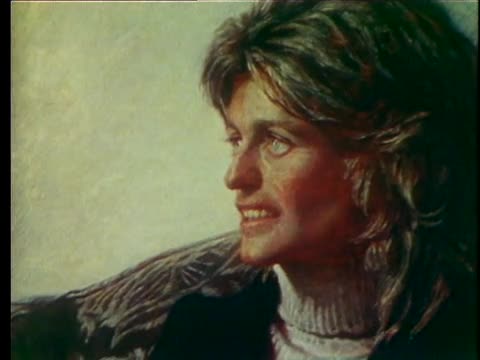
- [Description from the original press release] "A Portrait of Jamie" is a 30-minute study of Jamie Wyeth, not as a member of the dynasty of nationally recognized artists, the Wyeths, but as a person in his own right, with his own lifestyle as well as his own artistic style. Interviewed in a rural setting by Rod Bates, Nebraska ETV Network producer-director, Jamie Wyeth relates some of the inspiration, extensive study and detailed preparation behind his paintings as well as his personal reflections on his subjects. Jamie Wyeth inherits a lengthy tradition from his father, Andrew Wyeth, and his grandfather, N.C. Wyeth. Among the young artist's better known paintings are a portrait of the late President John F. Kennedy, painted at the request of the Kennedy family, which was exhibited on the American Freedom Train, and the portrait of Thomas Jefferson commissioned by TIME Magazine for their Bicentennial issue. Each of his paintings has a story, many of which are told in "A Portrait of Jamie" in Wyeth's own personable way. The paintings entitled "Shark" and "A Portrait of Lady" have particularly fascinating stories behind them. Paintings (and details of paintings) from an exhibit at Omaha's Joslyn Art Museum help to illustrate and reinforce the ideas Wyeth expresses in the program, completing a unique portrait of an artist.
- Asset type
- Program
- Rights
- Access to material from Nebraska Public Media’s archival collection is for educational and research purposes only, and does not constitute permission to modify, reproduce, republish, exhibit, broadcast, distribute, or electronically disseminate these materials. Users must obtain permission for these activities in a separate agreement with Nebraska Public Media.
- Media type
- Moving Image
- Duration
- 00:29:41:28
- Credits
-
-
Interviewee:
Wyeth, Jamie
Interviewer: Bates, Rod
Producing Organization: Nebraska Public Media
- AAPB Contributor Holdings
-
Nebraska Public Media
Identifier: cpb-aacip-c26c8d41d18 (Filename)
Format: Betacam: SP
Duration: 00:28:05
If you have a copy of this asset and would like us to add it to our catalog, please contact us.
- Citations
- Chicago: “A Portrait of Jamie,” Nebraska Public Media, American Archive of Public Broadcasting (GBH and the Library of Congress), Boston, MA and Washington, DC, accessed November 24, 2026, http://americanarchive.org/catalog/cpb-aacip-930980074cc.
- MLA: “A Portrait of Jamie.” Nebraska Public Media, American Archive of Public Broadcasting (GBH and the Library of Congress), Boston, MA and Washington, DC. Web. November 24, 2026. <http://americanarchive.org/catalog/cpb-aacip-930980074cc>.
- APA: A Portrait of Jamie. Boston, MA: Nebraska Public Media, American Archive of Public Broadcasting (GBH and the Library of Congress), Boston, MA and Washington, DC. Retrieved from http://americanarchive.org/catalog/cpb-aacip-930980074cc