Ernie Chambers: Still Militant After All These Years
- Transcript
I'm sorry I am the other the one that we always is Black People Poor Treaties being in America and what I'm doing here is why white people wish no Black People could get into office Senator Chambers is dog they want to know you know when I decide that I'm搞off a target I'm ready to do it He is determined And he My flame Never revenue My fire is never banked. He just is, is unwilling to play the game that is most often played in state politics. And you all can go along to get along, but I won't. It's one of those kinds of individuals. You know, you always hear people say, well, if we didn't have him, we'd have to invent one. I don't think you could ever invent this character again. I mean, I really think he is that unique. Bernie
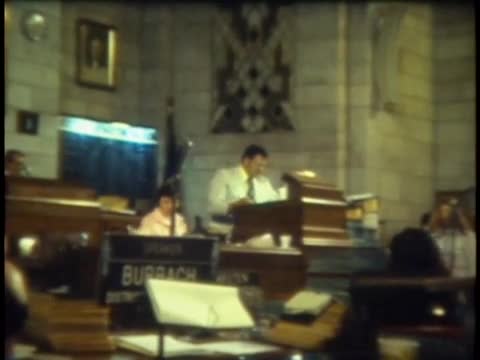
Chambers is indeed a unique figure on the political landscape in the state of Nebraska. He is the lone black senator in a primarily white state. He is the only African -American to ever run for governor and the U .S. Senate in the state's history. And since his election as a state senator in 1970, Chambers has been the consistent moral voice of the state legislature and the most controversial. Mr. Chairman, that is uncalled for it. If he wants to call me a liar, let him call me a liar outside. I think Mr. Chambers is one of the most brilliant men I've ever been associated with. And the only problem he got is he just hates white people. And he can't get over it. I think same with the Chambers being just like my seven -year -old kid again. He just, okay, I'll say this, and she, look at all the attention I'll get. A lot of what I do in this legislature is symbolic. It's to show us that one
black man can stand against and among all these white people. Don't walk like him, talk like him, dress like him, do anything they do, and yet compel them to knuckle under on issue. Chambers, oh, okay. I want to let people see me out here working. You know what I mean? We'll go to sweat. Thank you. Working hard. All right. I'm a politician. There's nothing dirty about the term. It's those who've carried it that have solided. But I'm a politician. Ernie's a true representative. He doesn't have any alter your motive. He's not political. He is truly a representative of the people. There is a group that is organized to help me. But I told them that I'm going to work too. Because I'm never going to let anybody do more for me than I'll do for myself. Ernie Chambers is a maverick. He is fiercely independent and he holds no party affiliations. I can't think of an organization. Ernie is actually ever really
belong to active in, okay? I think if there is such an animal, it's the community. Okay, that he belongs to. It's the community that he represents. I don't know if you remember me. I knew you as a little kid many, many years ago. Chambers was born in this neighborhood, the son of a local minister. Other than a stint in the army, he has lived here all his life. That tells people how to vote for me. I know y 'all aren't old enough to vote. But where you are, so if you haven't registered, uh -huh. For over 25 years, he has represented the 11th legislative district, Omaha's near north side, the largest concentration of African -Americans in the state. Largely overlooked, this community has confronted poverty and indifference for generations. It was from here that Chambers emerged onto the political scene out of the turbulent and volatile years of the 1960s. Blacks in our community in the 1950s
and 1960s found their aspirations, their hopes dashed time and time again. It was a matter of power. It was a matter of a lack of power, you may say, because there were certain places that black folks couldn't let go. You didn't know you were not able to live where you wanted to. There were certain jobs you were restricted to. Our community, you know, any fact had signs posted all over saying no blacks here. In the early 1960s, the push for employment and housing was in full swing. In Omaha, Negroes were segregated into decaying neighborhoods by restrictive housing practices. They kind of situation which lends itself to the restriction of persons and the choice of their residency, bring about a lot of undesirable circumstances. They take on and become generalized individuals. They
took their grievances to City Hall, but were unable to win open housing ordinances needed to alleviate the severe overcrowded living conditions. To bring attention to their plight, non -violent mass demonstrations were organized. Back in those days was the day of organization. With the purpose in mind, the purpose was to achieve a better way of living to realize the American dream, if there is such an animal. The marches gained wide community support. A young Ernie Chambers took part in them as well. And as the list of grievances grew, these protests took on various forms, including one incident that stood out from all the rest. In 1963, Chambers, then a postal employee, confronted supervisors there of repeatedly addressing him and other black male employees as boys.
He was fired for insubordination. Although granted a hearing, he was not reinstated. Ernie Chambers did not stop there. Shortly after the incident, Postmaster General J. Edward Day arrived in Omaha, at a testimonial dinner, he praised the department's record on the hiring and promotion of Negroes. While 900 dined inside, outside Ernie Chambers paced the sidewalk alone. He had his picket sign by himself, and he marched around the hotel and stood for what was right. And I thought that was very courageous, because most people won't take individual stands unless there's a group behind them, or if you got my back, I can do it. This low -nactive descent went largely overlooked. However, it did come to the attention of the FBI. The bureau had begun monitoring Chambers' activities two years
earlier, after accusation's surface that he might be a follower of the Honorable Elijah Muhammad, allegations that later proved unfounded. To combat segregation, integration became the thrust of the civil rights agenda. The leadership at that time was dominated by black ministers and professionals, along with sympathetic whites. And while this strategy broke down barriers to opportunity for some, many of those benefits did not immediately trickle down. Those who broke through moved out, draining the community of the valuable assets essential for healthy neighborhoods, higher income, stable family households. By 1965, the philosophy
of non -violence stalled. Across the nation, demonstrations gave way to wholesale, looting, and burning. Disturbances also chipped away at Omaha's near north side. Those who were idle and impatient for change took their frustrations to the streets. Most often, outbreaks were sparked by incidents with police. If too many gathered on the corner, they would talk to you and get off the corner, busted up. And if people didn't move fast enough, the police were out of the car. And they're, by, developed confrontations. We'd be in the opener of our eyes and see what was happening. You know, we were the other generation there. And we'd begin to realize that mom and dad had gone through. And when we came along, we're not going to take that. We're not going to accept it. City after city, block by block. Young people defied police driving non -violence off the map. With this revolt, came a need for younger, more militant leadership. And in
Omaha, Ernie Chambers stepped in to fill that void. I can remember several incidents with Senator Chambers where he was one way or the other. Either he was able to calm the storm, if you will, or he was able to stir the lightning, if you will, depending upon the circumstances and whatever the need was. A barber by trade, Chambers brilliantly articulated the ambivalence and anguish of a community turned in on itself. He was white America's worst nightmare. He did not go unnoticed. Chambers exploded onto the national scene when featured in a time for burning, a documentary examining race relations in Omaha's religious community. The problem exists because white people think they're better than black people, and they want to oppress us and they want us to allow ourselves to be oppressed. This is the way I agree with you. Perfectly, this is the basic problem. Then what do you think white people think they're
better than others? I can't solve the problem. You guys pulled the strings at closed schools. You guys draw the boundaries that keep our kids restricted to the ghetto. You guys write up the restrictive governance that keeps us out of houses. So it's up to you to talk to your brothers and your sisters and persuade them that they have a responsibility. We've assumed ours for over 400 years, and we're tired of this kind of stuff now. We're not going to suffer patiently anymore. No more turning the other cheek. No more blessing our enemies. No more praying for those who despitefully use us. We're going to show you that we've learned the lessons you've taught us. We've studied your history, and you did not take over this country by singing We Shall Overcome. God bless you guys, brother. We're your master. Come back and see us again sometime. Man, don't look back at anger. Thanks for taking it so well. He thought we were going to do it here like they do to us. If we went in one of their places, everybody would have jumped out their chairs and got some ropes together and hung one of us. Here's a monster, a young black man. The barber, all of a sudden hitting
the headlines and becoming a national figure, and certainly a statewide figure, saying these kind of things was unheard of. He was imputent, if you will, uppity. And you know how dare he or any of us speak this way to the like the Native Americans say the great way to fight it. By the late 60s, the Freedom Movement had changed course. For those in the inner cities, the rallying cry for integration was replaced with a call for community control. A greater say in local politics. Black control of black neighborhoods. This fundamental shift brought with it a new identity and a new political direction. Black power. With the passage of the Voting Rights Act of 1965, black power became a reality, at least in the voting booth. Across the country, blacks began electing blacks
to office in unprecedented numbers. Between 1968 and 1974, the number of black elected officials increased fivefold. But in Omaha, getting blacks elected to citywide offices would prove more difficult. The city was overwhelmingly white. Political opportunity, yes. The ballot box was available, but the results were always white. They just weren't black. With much of the focus now shifted away from the streets and into the political process, Chambers decided to run for the Omaha School Board. The school board used to have slates. They would pick five people and endorse them. That endorsement was the kiss of success. And so that person had to be someone that the school board was comfortable with. That person was not Ernie Chambers. My name was offered as a write -in. And we had signs on buses with a
big pen saying, write -in Ernie Chambers. And it generated a lot of interest, not just in the black community, but throughout the city. And I got a respectable number of votes. But there was no way that I could win that office, running for the school board, no way that I could win as a write -in for the city council. The one office blacks did control was the state's 11th legislative district. For generations, the predominantly black district sent a representative of its choice to Lincoln. For most of the 60s, Senator Edward Denner represented the 11th district. A champion of human rights, he served as community well, with a devotion to minority causes and a commitment to the struggle for civil rights. And if there are much political connections he has, they're sending it up top of the bill. It guides the destiny of all of us.
In January 1970, he died while in office. George Althouse, a conservative Republican businessman, was appointed to complete the term. In his only address on the floor of the legislature, Althouse made remarks some in the 11th district found disturbing. When he came down here, they met during a special session and toward the end of it. I guess the euphoria of being around all these white people overcame him, and he stood up and said, God created white people to lead their superior to black people and so we should just follow along behind them and do what they tell us to do. And someday we'll all sit down and say, God bless America, where's that effect? Most devastating. I think you not only shocked black folks, okay? But I think even shocked those white folks that might have had those films, but wouldn't have said it. Senator Althouse was a nice person, but in reference to his role in these state legislature, he was more of a setback to the black movement than a progressive activator for black
rights. So what black people in the community asked was whether or not I'd run against him, and I tried to get others to do it, but nobody wanted to, so I ran against him. During the campaign, a police officer was killed by a bomb planted in a deserted North Omaha house. Police scoured the area in an effort to find those responsible. Under the pretense of an investigation, black citizens are being snatched from cars and beaten on the street. Clearly, a concerted police attack is being made against the entire black community, testing to see how much injustice we will tolerate. They're watching to see if we'll forsake our brothers whose only crime is being black, a crime of which we are all guilty. Two local black Panther members were charged in the killing. There again is where Ernie shined if there were
incidents, there was no identifiable leadership that would go down in mass to protest the treatment of a particular citizen. But there's Ernie on the scene that would go as an individual. All tiles preferred quiet negotiating. On the other hand, Ernie meant no words, citing white racism as the major problem facing his district. It was a bitterly fought campaign. And in November 1970, Chambers defeated the incumbent by only a few hundred votes. And my community shows this disrespect for me by sending me back time after time, after time. He would take his grassroots confrontational brand of politics from the streets into the halls of the conservative state legislature. The angry black militant was about to enter the political mainstream. There are some communities in Nebraska which are out of touch with the trends of this
modern society, this modern world, and these particular communities have to be dragged, even if it's kicking and screaming, into the 20th century. Ernie and I came in both at the same time. It's fears and trepidations from you name it. Both came in. I remember that first day. They wouldn't allow me in because I didn't have a past. I didn't look old enough. And they were convinced I was a student rabble -rozer and they wouldn't let Ernie in because he had a t -shirt on or something. We both got in. To say the least, he was not your typical senator. To this day, he refuses to adhere to the unwritten dress code and wear a suit. And because of his reputation, there were concerns about security. And when I came down there, they were so terrified of me that they drilled holes in that beautiful wood in the ceiling of the chamber and installed these television cameras so they could keep an eye on me and brought state troopers into the chamber.
Because they thought I came down here to do physical battle. They had cops and everything else posted for security because of Ernie and whatever. In the first months of the session, chambers in DeCamp visited each other's districts. They realized almost immediately that the problems facing rural and urban communities were not that different. Well, if you don't have jobs, if you don't have employment, if you don't have the flow of funds, you've got problems, whether you're living in the ghetto or whether you're living in outstate Nebraska. And if we function as a team working on some of these problems together, we won't agree all the time. But we'll agree one hell of a lot of the time and learn a lot about each other. We can make some difference. And that was kind of the policy Ernie and I followed, as I say. And I think we made a lot of change, a lot of difference. And sometimes we disagree. And when we disagreed, they were epic battles. Now realize that this bill was introduced by Senator Chambers, whose expertise in rural Nebraska, I would guess, is probably less than some
of the other senators in this room. Senator Chambers has stated on more than one occasion, in fact, I've heard him state it on this floor, that until you've walked a mile in his shoes, you really don't know what it's like, for instance, to live in the ghetto or suffer racial prejudice in this type of thing. Well, I would suggest that until Senator Chambers has walked a mile in the shoes of our rural senators, and has some knowledge of what the climate and walking conditions are like, that he not try to prescribe the size of shoe we should wear and how to walk. And with that request, I would say we should kill this bill and send it to the happy hunting ground of bills that are before their time or don't fit the needs of the people. Mr. Chambers. Mr. Speaker and members of the legislature,
it always gives me great pleasure to do battle with my friend Senator DeCamp, although I generally feel like a bully, it's not right to put a heavy weight against the lightweight, but we do have certain understandings between ourselves, so I'm not going to talk about that. To having a great battle with Ernie was war and Vietnam. I enjoyed battles with Ernie probably more than anything with certain limited exceptions in life. I don't think anything I say could change anybody's mind. I'm aware that once the champion of rural Nebraska and the agricultural interest of the state gets on his white horse with his long jaws and goes after the windmills, a barber from Nebraska from Omaha, Nebraska doesn't have much chance. I'm at my age 73, I got all my cheats, except a couple of wisdom teeth, and you can understand why they're gone.
The legislature at that time was dominated by the irrepressible Terry Carpenter. He has been called the greatest single influence over the Unicameral. He dominated debate so thoroughly, the body created the 10 -minute speaking limit because of him. It didn't take him long before he recognized a formidable colleague in a young Ernie Chambers. As far as knowledge and capabilities and debate, he has no power in the states, and he has a great capability, and some of it is, and he's done a lot of good. Through his mannerism, the action, he's helped the people in the penitentiary, and the people in the women in there. He's done a lot to scare almost every lawyer in the state of Nebraska. He's the only one as ionist, and whoever had the complete Supreme Court sat down and listened to him, when everybody else is even afraid to even look at him. He's done a remarkable thing, and he's a man of contention.
And if he would settle down, which he won't, he's a very respectful one. We clashed the first day that we had a full legislative session because Nixon was going to come to the campus. Some of the students wanted to wear black arm bands on a stage or something, and the legislature got all upset, and I stood up on the floor and defended the students right to do it, and Terry Carpenter was opposed to it, so we clashed the very first day, but I think that let him know that he was dealing with somebody who can think, and it let me know, that there was somebody down here who even though I disagreed with him, could think, and I'd have to cultivate him, iron sharpens iron, and as the years passed, Terry and I developed not only a respect for each other, but a cordial working relationship. Donna, the Chief Justice of the Supreme Court of the State of Nebraska. Gentlemen, please raise your right hand while I administer the oath. In 1972, Chambers was reelected to his first full
term. He quickly rose to chair the Government and Military Affairs Committee. The consummate outsider was now inside amongst the powerful. He immediately focused his efforts on changing election laws in the city of Omaha. It was the contention of Senator Chambers, who was a primary movement on the election bills, that the at -large election of members of the school board and the Douglas County Board and the Omaha City Council worked a real hardship on a minority community, because blacks, as such, could never get black representation on any of those bodies. They simply were outnumbered by whites, and whites, according to Senator Chambers, consistently voted white. The name recognition was in the powers that be and in the white community, and simply put, white folk
wouldn't vote for a black person. No more they didn't know them, and if they did know them, they wouldn't vote for them anyway. His first point of attack, the way members were elected to the Omaha School Board. For years, Chambers had been the most outspoken critic of the Omaha Public School System. He consistently attacked the board for what he believed were the school system's segregated practices. Two years earlier, the Justice Department had concluded that the schools were indeed unconstitutionally segregated and looked to the board for a resolution. They said, look, if you will take responsibility for desegregating a handful of schools that we think are high impact schools, then we will let you alone. If you will discontinue certain, racially biased transfer policies, we will let you alone. If you will do a couple of other things, then we will let you alone. The price that the Omaha School District would have had to pay back in 1971 to
desegregate the Omaha Public Schools by settlement was relatively modest in the greater schema things. But the Omaha School District decided that it was not guilty of any wrongdoing and so it chose not to settle. Getting district elections through the body would be an uphill climb. Chambers had to convince 24 others of the merits of changing the election laws for the state's largest school district. Senators John DeCamp and Terry Carpenter lined up alongside Chambers and were instrumental in maneuvering the bill through the Unicameral. The original district elections bill was my bike path bill. And when the legislature most of them would skip out on Friday afternoon, we'd got that bill and put the district election bill which they had trapped. We'd put it in there and we'd roll it. And they'd come back on Monday and undo it. I don't know how many times we did that. But I know what it is. Senator Carpenter, on the other hand, cleverly cautioned colleagues against playing into Senator Chambers' hands.
He said, you know what? Senator Chambers does from what this bill? He tricks you all the time. What he wants you to do is kill this bill. Then he can go back in his neighborhood and hang you up on the telephone pole and tell how all of your racists and your unfair. But I'll tell you what y 'all to do. Don't give him what he wants. Pass this bill. Three times in four years the Nebraska legislature did just that. And each time the bill was vetoed by then Governor Jim Exan. Finally, in 1975, Chambers was able to muster up enough support to override Exan's veto. The battle to get district elections for school board members lasted five years. And he didn't stop there. It's too much to expect that a council member from a far west suburb could have any realistic comprehension of or concern for the lifestyle and problems of citizens residing in the lowest quadrant of the city whether they be black or white. With the school board now elected by districts, Chambers again
sponsored legislation that would impose district elections on city council members as well. No black had ever been elected to the Omaha City Council. Public hearings were held and the black show of support was overwhelmingly in favor of the proposal. There are some 40 ,000 plus blacks in the city of Omaha who are not represented on this body. And you, at this point in time, have the opportunity to correct what is a very grave deficiency in city government. And particularly in regards to the representation of blacks in the policymaking and decision making bodies of this city. There was considerable resistance within the city council to district elections and testimony before the council fell on deaf ears. City council people have been elected at large for a long time. And city council people had seen the possibilities of district elections being shoved down their throat. So they had actually put the issue on the ballot. They
had given it to the Omaha voter in the early 1970s, not once, not twice, but three times. And the Omaha voter being the white voter with a small black population consistently voted for the at -large elections. Undaunted, chambers moved ahead with his bill. He declared representation to be a constitutional right and not to be left up to popular referendum. Critics and supporters alike packed committee hearings in an attempt to sway senators. What we want to do today is try to indicate to the legislature that the people of the city of Omaha have indicated they do not want this. And that if in fact, we are to have district elections of councilman in the city. Let's let the people of the city of Omaha make that decision. We have to have representation by someone on the city council who can put in their two cents for our area.
On the floor, district election legislation passed easily through first and second round debate. However, it failed to gain final approval by four votes. It was the last day of the session and it looked as if time had run out. The city council bill was killed, but then I worked with some people over the noon hour and we resurrected it to the Omaha. The mayor then was Al Vaze. Some of the city council people partying all the way back to Omaha happy because the bill didn't pass. Then they got there and turned on television to find out that the bill had been revived and it had been passed and thomed signed it. And they were really angry. They thought I was the devil incarnate. And that during such time as I am in this position. After a seven -year effort, city council members would also be elected by districts. The final piece of the trilogy, the Douglas County Board, would not follow until 1992, a considerable
triumph for one person. Senator Chambers, long and hard, diligent work, and persuasive argument was able to eventually get district elections for most of the political entities in Douglas County. He could really run that flag up the pole. I think the purpose of government is really to give voice to those who make up the community. Fred Conley benefited directly from district election legislation. He became the first black and Omaha's history to sit on the city council. People here, I think if you were to poll them, what honestly say that district elections has been better in terms of representation of them than under the at -large system. Because at least now people have someone they can call. They have a representative. Whereas under the at -large system, they really didn't know who to call. And so now they've got a direct voice, a direct line to the person that they say represent their particular area of town. I think that's really the purpose of government, is to give representation to those who feel unrepresented at times.
Please stop, Africa. In the coming years, Chambers would shift his attention well beyond the boundaries of his district by co -sponsoring bills that addressed national and international human rights issues. In 1980, along with Steve Fowler of Lincoln, he persuaded the Nebraska legislature to pass a resolution, condemning the South African system of apartheid. This resolution urged state officials to halt investments in corporations and banks doing business in South Africa. It became the first legislative action of its kind in this country. In 1989, at the request of the Pawnee, Chambers sponsored a measure that would force museums to give back the skeletal remains of Native Americans for rebarial. It was the first such law passed by a state legislature and went on to become the model for the federal regulations that followed.
His interest in human rights issues now moved far beyond the confines of the 11th district. His impact was now truly international. In spite of his remarkable legislative achievements, one objective remains beyond his reach, the repeal of the death penalty. Execution sequence began at 12 .14 a .m. Sequence ended at 12 .15 a .m. Death was pronounced at 12 .22 a .m. The state of Nebraska has resumed executing those who commit what the state considers the most heinous crimes. In an unusual turn of events, Chambers volunteered to serve as an official observer for John Jupiter, executed for the 1983 killing of two young boys.
It's not something I wanted to do, but because of some circumstances that developed, I felt that I should be there as an observer. The sentence on John Jupiter is death, and I want to be sure that the state's killing machinery does nothing more than take his life. I'm opposed to the death penalty under all circumstances, but since they're going to do this grisly, hideous thing, I want to be sure that they don't do anything more than that. Session after session since 1973, Chambers has introduced a repeal measure before the body, and vows to continue speaking out against capital punishment as long as he's a state senator. I don't have the votes to whip you on anything in a fair fight or an unfair fight. So I'm not even going to talk about fairness. That's out the window. We're at the top. Often outnumbered, Chambers finds it difficult to advance his own bills, and must use every device to promote and protect minority positions and interests. So I had to mess with other
people's bills. I had to offer amendments. I had to fight against bills that I did not like, and I had to force them to respect me for what I knew. One way Chambers has made his presence felt is with his extensive knowledge and use of legislative rules. On this proposed rule change and on other things this session, we're going to fight like scorpions in a bottle. I promise you that. Well, he has a reputation as being the most skilled user of legislative rules that exists. Senator Lindsey, I think you've created an unconstitutional scheme here, and it'll be good if it stays in. I'm a teacher. He's talent. Generally speaking, if you're going to pick a talent of Bernie, he put it where it could do it. And that was in stopping things. The fact you could be charged with a felony or a misdemeanor, and the court said, no, you can't. You cannot take the same facts and make it either a felony or a misdemeanor.
There's another way of stopping. And this is where Bernie is most effective. He might gently, gently point out through analogy, through slow, simple examples of education of the legislature that this isn't going to do what they want. And so a little amendment here, a little amendment there, a subtle change, that can be far, far more important. I say, I moved to kill LB such and such, which he may not have the votes to do. In fact, he wouldn't. I learned very quickly, I'm a quick study. One strategy Chambers has used with great skill. In stopping or shaping legislation has been the filibuster. He slows the process way down. I used to be crazy on that. My first year was like, what is the point here? You've talked for eight hours. You know, we know, let's vote. I think that's everybody's initial reaction is, hey, I came here to vote. And you've slowed the process down to a standstill. But in the same way that I've done it tonight, I will do it every day for the rest of the session. And if you think I won't heart back to the abortion
bills, where it was virtually me, all day from morning until midnight, and said, that's what I do. And I promise you that I will do it. We're not there to demand our way. And that's what Senator Chambers will do. And that tactic makes people furious more than anything. Senator Chambers doesn't need the approval of his colleagues. You know, there are a number of legislators who would not be inclined to filibuster. Because to filibuster might cast them in a bad light in the eyes of some of their colleagues. Or they might think it would cast them in a bad light in the eyes of some of their colleagues. Senator Chambers has never worried, about what his colleagues might think. If he thinks that to stop a bad measure requires a filibuster, requires an exhaustive use of the rules, a tedious use of the rules, he'll do it. President, the next member has a question. Over the years, the
legislature has adopted rules that would end extended debate on a bill and bring it to an immediate vote. I can't stand hobbles, and I can't stand fences. Don't fence me, and that's what they thought they were going to do. So they have fabricated all kinds of rules to end debate, to prevent the offering of amendments and motions, but I can always find a way around it. Frankly, many times these are rules written to try to find a way to cut into Ernie's talking all the time. They don't work. We ought to acknowledge they don't work. It's one of the reasons Ernie fights so hard on them, but in fact, he actually doesn't have to win these fights because the way we write these rules, he can beat him anyway. He can beat this rule. This rule will not capture and cut off from debate, Ernie Chambers, on anything he wants to talk about. It's not going to work. The reason it doesn't work is because we try to write a rule one moment at a time to capture the last strategy
that Ernie used to get his say. And then we try to catch up to that. And then there's another, it's like Swiss cheese. There's another place in the rules to do. And Ernie's a master at it. We should stop trying this mechanism to do it. It doesn't work. I've already told you all that I watch Houdini movies. They put him in the hermetically sealed box, wrapped chains around it, put it in a burlap bag, and drop it in the ocean. Then after enough time for him to suffocate it, they pull it up, they remove the bag, they take the chains off, they open the box, and it's empty. Winning takes different forms. There's a short range view and a long range view. The long range view relates to what the ultimate outcome of the issue is. So they may even be able to invoke cloture and feel like, how have we won? But then as other bills start backing up, because I do the same thing on other measures, and in time is on my side, they then want to reach some compromises and make some changes. Does everybody have
to reach a compromise and change with you? I mean, you're almost coming off like you're another house in the body. I am the second house of the Nebraska legislature. I'm the only reason they can refer to the legislative chamber, plurality, the legislative chambers, they say, there's that chamber with them, and then I who am in the chamber, whose name is Chambers. So they are, in reality, my legislative chambers. If I allow a vote, and believe me, it's up to me to allow it, because this morning, for this short time, I own the legislature. No, he doesn't. He likes everybody to think he does. I mean, he'll control a bill for day or two or for a week maybe, or maybe for a few hours, but he doesn't control the agenda. He knows that. I own you. You are my legislature. I feel like a duke or an url, or whoever is in charge of a fiefdom. I think power does corrupt.
An absolute power does corrupt absolutely. So it's probably good, I only have two hours, during which to exercise this awesome power. He knows that when he says that, it irritates folks on the floor, and which is part of what he's trying to do, because he gets them to sit up and take notice of nothing else, then they're listening to him. Chambers' speeches on the floor of the legislature are legendary. He can lecture, preach, and on occasion sing without missing a beat. But there are appropriate words from a song at this time, like a bridge over troubled waters. That's what I will be. This discussion was going along with it. There's like different modes that he switches into. He'll be at just kind of a regular speed where he's having some disagreement, and then if he's really upset with you, he'll switch into that high gear mode where he starts ranting. I mean, I don't know whether any of the word for it. You cannot even pass a budget. You put the rules
in place that I voted against, and now you won't follow your rules, and I told you that the day you adopted them, your rules would bite you before they bite me. And the most important thing that you do as a legislature is to build a budget, and you won't even pass it on the day that the rules you all adopted say you should pass it. First, he asked to wake him up. And he asked to wake him up sometimes by, you know, insulting them, or if nothing else rubbing their nose in a little bit. What will you do if the bill goes back to the committee? You'll wind up making all this noise like the mountain, and then it will bring forth a mouse. You've got these political bills like that. He's developed over the years probably one of the best. Systems for gentle education. And sometimes that gentle education takes a back seat to the hammer on the nail real hard, because that's what's needed at the time.
Chambers' verbal tirades seldom go past critical denunciations, but as debate wears on, and exchange becomes heated, tempers can flare. Senator Butler. I want to make a couple of comments. Okay. You are closing. I'm not going to comment on Senator Chambers remarks, except to say that I think he's been totally dishonest. It is Senator Chambers who has been manipulating this process, and for him to stand up and assert that it's the rest of us that have been manipulating this process, is a ball -taste lie and he knows it. That's all I'm saying about that. Mr. Chairman, that is uncalled for. If he wants to call me a liar, let him call me a liar outside. And we can handle that, not on my name saying anything in his clothes that he wants to. But when we're on an issue where opinions can differ, that is something which he's not going to call me a liar on. If he said that I accused him of something and shows that what I accused him of is not true, and I knew it was untrue and did it, he can say liar and a liar I am. But to talk about
manipulation, he's not going to call me a liar on that. Okay. I've given equal time. Did you finish closing, Senator Butler? Mr. Speaker, I am going to speak the truth as I see it. And I am tired. I really almost think he's kind of schizophrenic. There's two different people there. There's one when he's on the floor on the legislature and he has this personality, this persona where he comes off and the media covers it and they make him up to be, you know, this bigger -than -life person. And then you get him off the camera, off the side and you get him alone and you walk down the hall with him. And he's just a very charming individual. It is consoling to me to find out that down deep he is human. And so as a result, on a half a dozen occasions, why he's taking steps down there that I think, you know, has got him into short -range trouble. But on the other hand, I think fair observers and evaluators have to come back and put those into a larger picture that perfection in this world is a rarity.
All this posturing, all this yapping by all of these white people about being angry at their white federal government. Then I hear these whiny, white men talking about how they're being discriminated against. But then when it's... Since he first entered public life, Ernie's biting commentary on race has left him open to allegations that he himself is a racist. There are those who have always found his discourse on race alienating and excessive. Most definitely he plays the race card. And I think he plays it when he doesn't need to. That's the thing that I don't understand. I think sometimes he plays the race cards for the television, for the people watching maybe, and for the people listening he plays that. And I don't agree with that. I think it's more damaging than helpful. White men control the U .S. Senate. White men control the U .S. House. White men control the U .S. Presidency. White men control the U .S. Senate. There are
many condemnations that clearly deny the humanness of the individual white, the essential humanity of whites, that are remarks that I would find offensive, that are remarks that are racist in nature. That are remarks that I don't think are very productive. But generally speaking those remarks make points that probably need to be made. White men control the movie industry. They control the publishing industry. They control the finance industry. What do they not control poverty? Ernie is not a racist. If you speak out in behalf of yourself, they call you a racist. That's a misnomer. That's the name he doesn't deserve. He's not a racist. I've seen Ernie speak in behalf of people
of color, people of non -color. He doesn't care who it is. He wants to be fair. Well, let me tell you this, my white brothers. You give to black people what you are laboring under. We'll gladly assume what you call discrimination and reverse. I don't have to get along with white people. I don't have to make them like me. I don't have to make them think that I like them. As hellishly, as black people are treated in this country, I would be totally dishonest if I gave the impression that all is well with the world for us. I'm resentful toward those white people who want to try to give the impression that everything is all right and I'm extremely bitter toward the black people who get into that hypocritical dishonest bag. Things have not improved. Central Chambers is there, I think, to antagonize. My opinion is there mostly to antagonize the white people in the chamber, you know, versus what they can do for his community. Well, it's Thursday, nine o 'clock. I'm here
again. Each week, Chambers conducts office hours over cable TVs public access channel. The program allows him to take calls from viewers who in turn discuss issues and events not often covered in the mainstream press. What I wanted to know is, you know, I was looking at the news and they were saying about those two juvenile charged with accessory to this murder. Do they have some type of a different one for them or what? To my understanding, they all have lawyers at this point. Here's a man who's supposed to be representing an area of Omaha that's got some of the worst crime in the state and he is always in there for the criminal. He truly is. Right today, the leading cause of death. To young men, 15 to 30 years of age is homicide as a direct result of black owned black crime. As a direct result of that, black people are the most victimized group of
people in this country. But do you know what our black politicians talk about? Racism in the criminal justice system. This system was built and is maintained to keep us in an inferior status. Read the laws, look at the court opinions, just the other day came down a study which documented through the study of thousands of cases what we already know that black people get sentenced for things white people don't get sentenced for and when white people get sentenced for them, the white people get a much milder sentence. All it's saying is that the racism is still here and I'm going to fight it and I'm not going to apologize and I'm not going to let the white people off the hook. Since the turmoil of the 1960s, one of the major problems
facing North Omaha has been economic development. Why would you someone be in office as long as he has and take a look at the district in which he's represent? What's the problem there? Never felt that Senator Chambers has been as profound a proponent of the great society, so to speak, it's never been as important a cause as has civil liberties. So I suspect that there could be some of his constituents that could say, you know, in the end, Senator Chambers, you've not done enough for our district in terms of jobs, in terms of public work, in terms of public benefits, in terms of the other kinds of aspects of the great society. Ernie is not a believer. Contrary to what some people would like to think, Ernie is not a believer and will give me a pile of money and everything will be wonderful, you know? He's a believer that you have to change conditions, you have to change people's attitudes, you have to change
some of those things and the rest will follow and does it happen immediately now? If Ernie had not been in the legislature making the noise he's making now and made in the past, we'd have even less than we have now. We would have nothing because there wouldn't be no other voice. There hasn't been any leadership to speak of as strong and as vocal and as present as Ernie Chambers in my 58 years in a long. Yeah, this is Senator Chambers office. I don't know how you're doing this morning. Listen, you have a good day today, it sounds like. I think there's still sort of a messiah complex in the black community. Black people still believe that someone is going to come along and save them. My contention is that single black elected officials elected to city councils and state legislature are not going to change the conditions of the black community in their lifetime. Unless there is a
galvanization of the community based upon the churches, the social organizations and other people concerned about the community. Unless they come together and initiate projects no matter how many black elected officials you get elected in this country. It's not going to change the plight of black Americans. The reality is that there are certain things that are needed to make it alone that we don't control at this point. And one of the reasons we don't control them is because our minds are not focused. When I talk about looking inward, I meant to recognize our blackness and be proud and have self -respect and insist on better treatment than we receive. And if they say there's something behind that door to which every citizen is entitled and we knock on the door and it doesn't open, then we need to break it down. Little has changed philosophically for Ernie Chambers. Over the years, he has remained true to his militant roots. He has worked tirelessly for the people in his district. Always ready to speak out in defense of the unpopular.
He is a stellar example of the difference one person can make. If the one person is made, one person can and will make a profound difference. And if other people observe and arrive at the understanding that they don't have to imitate or duplicate somebody else but use the abilities that they have, the talents that are theirs and achieve the things that fall into their hands to achieve, they will make a difference. Here's a guy who works for $12 ,000 a year plus expenses. And if he would put on a suit and a tie and go out in the private sector, he can make a quarter of a million dollars easy as an attorney. Without batting an eye, he could do it probably in whatever area he chose to. But by working for the people in his district, by working for the state, because he truly is a state senator in that what he does benefits the entire state.
He is priceless. I think it's going to be difficult for the person who is standoffish, kind of a loner, won't get into harness, is not identified with the powers to be. It will probably be more complicated in the future for them to be as effective as he has been these past 25 years. He's a constant monitor. He's a constant reminder that someone is watching that you may do wrong, but you're just not going to be able to bulldoze over people. I intend, as long as I'm a member of this body, to use this platform and this forum to bring before the state to the extent that I can. These types of issues and let those people know who think they have a friend nowhere they have at least a voice in the legislature. This is my doing. This is my domain. This is my empire. I'm ruler of all that I survey.
I can make you angry and you can't even do anything about it. You need to have somebody tell you this is nonsense. This is silliness. This is stupidity. I could carve from jello a legislature with more backbone than this one. Why do the wicked grow old and prosper? Now I'm growing old but I'm not prospering so I don't have the qualifications for wickedness. When you see me, you're not seeing the best that the black community can offer. You're seeing that which they felt they could spare by sending me down here to the legislature to muddle and be fertile. You ought to be thankful. You're in a legislative body dominated by white males and you ought to be thankful that I'm here instead of an anarchist throwing bombs and organizing people in the streets as I very well could do. Others fold too quickly but I'm like that old check that they used to send you. Do not fold, spindle or mutilate because this one will fight
back. How much time do I have, Mr. Chairman? About five minutes. I might just spend my time shuckling. Video tapes of Ernie Chambers still militant after all these years are available from GPM for 2495. Call 1 -800 -228 -4630 weekdays from 8am to 5pm central time. You
You can't wait to see you. Thank you very much.
You
You
- Producing Organization
- Nebraska Public Media
- Contributing Organization
- Nebraska Public Media (Lincoln, Nebraska)
- AAPB ID
- cpb-aacip-a7f3eccfa89
If you have more information about this item than what is given here, or if you have concerns about this record, we want to know! Contact us, indicating the AAPB ID (cpb-aacip-a7f3eccfa89).
- Description
- Program Description
- [Description from the original press release] "Ernie Chambers: Still Militant After All These Years," an hour-long profile of one of the most controversial people to have ever served in the Nebraska Legislature, will be broadcast Monday, February 3, at 7 p.m. on the statewide Nebraska ETV Network. The program, which will be repeated on Sunday, February 9, at 11 a.m., traces Chambers' emergence from the 1960s when he first gained attention as a community activist to 1971 when he entered the Nebraska Legislature to today when he is recognized as one of the Legislature's most powerful figures. "Many people don't understand how significant a role he has played in the Unicameral," says Camille Steed, the program's producer. The program includes extensive footage of Chambers on the floor of the Legislature and interviews with current and former colleagues, friends and detractors. It also documents his political defeats and accomplishments, particularly his victory in forcing Douglas County political bodies—from the County Commission to local school districts—to adopt district election laws that enabled African Americans to win election to local councils, commissions and boards. "Ernie Chambers: Still Militant After All These Years" is a production of the Public Affairs Unit of University of Nebraska-Lincoln Television.
- Broadcast Date
- 1997-02-03
- Created Date
- 1997-01-02
- Asset type
- Program
- Genres
- Documentary
- Rights
- Access to material from Nebraska Public Media’s archival collection is for educational and research purposes only, and does not constitute permission to modify, reproduce, republish, exhibit, broadcast, distribute, or electronically disseminate these materials. Users must obtain permission for these activities in a separate agreement with Nebraska Public Media.
- Media type
- Moving Image
- Duration
- 01:02:56;13
- Credits
-
-
Producing Organization:
Nebraska Public Media
- AAPB Contributor Holdings
-
Nebraska Public Media
Identifier: cpb-aacip-31cc32dc495 (Filename)
Format: Digital Betacam
Duration: 00:58:27
If you have a copy of this asset and would like us to add it to our catalog, please contact us.
- Citations
- Chicago: “Ernie Chambers: Still Militant After All These Years,” 1997-02-03, Nebraska Public Media, American Archive of Public Broadcasting (GBH and the Library of Congress), Boston, MA and Washington, DC, accessed November 24, 2026, http://americanarchive.org/catalog/cpb-aacip-a7f3eccfa89.
- MLA: “Ernie Chambers: Still Militant After All These Years.” 1997-02-03. Nebraska Public Media, American Archive of Public Broadcasting (GBH and the Library of Congress), Boston, MA and Washington, DC. Web. November 24, 2026. <http://americanarchive.org/catalog/cpb-aacip-a7f3eccfa89>.
- APA: Ernie Chambers: Still Militant After All These Years. Boston, MA: Nebraska Public Media, American Archive of Public Broadcasting (GBH and the Library of Congress), Boston, MA and Washington, DC. Retrieved from http://americanarchive.org/catalog/cpb-aacip-a7f3eccfa89